Monday, 15 November 2010

Postcards from the Black Forest

This autumn we had the good fortune to make a couple of short trips to southern Germany.   The main one was to Freiburg in the Black Forest.  I had heard a lot about the Black Forest and how beautiful it was and of course I had eaten many a slice of Black Forest gateau, which is very popular in Scotland.  However I had no idea of just large the area is.  I thought it was just the southern tip across the border from Switzerland, but no, the Black Forest stretches all the way north to just before Karlsruhe.  Nearly 200 km in length and about 60 km wide it is a very large area indeed.


On this trip we only managed to get a glimpse of part of the southern Black Forest.  We crossed the border just outside Bad Säckingen on the river Rhine and headed north.  Unfortunately the navigator, yours trully, misread the map and we ended up taking a detour.  This had the advantage of letting us see some of the more isolated parts of the Black Forest.  It also confirmed that the area is well named.  There are a hell of a lot of trees and it does look pretty black most of the time.  The other advantage of this short detour was that just before we re-emerged on the main route we passed by a one family car boot sale.  More accurately the goods were on display in the family's garden.  We stopped and rummaged about and left with a fine range of goodies, including a scooter for Alessio.  All for next to nothing.


We continued on our route heading for Freiburg and around lunchtime as we passed through a winter ski resort, Muggenbrunn, we saw what looked like a delightful restaurant.  And delightful it was.  The Hotel Grüner Baum is in a traditional building and the restaurant serves traditional Black Forest food, all served by waitresses in traditional costumes.  It was a warm and sunny afternoon - what more could one want.  Here is a happy Emma relaxing after the meal.
Suitably refreshed, we were soon in Freiburg im Breisgau, our destination.  This is another little gem of a city and the heart of the Black Forest.  Full of beautiful old buildings and cobbled streets and alleyways.  Most of these old buildings were ablaze with colour and some were covered in ornate decorations.  You can get an idea from the collage below.
The main public space in Freiburg is by the Munster, a fine building itself.  The next photo is of part of one of the very colourful buildings in this square.  This is followed by one of the delightful narrow streets or alleys.

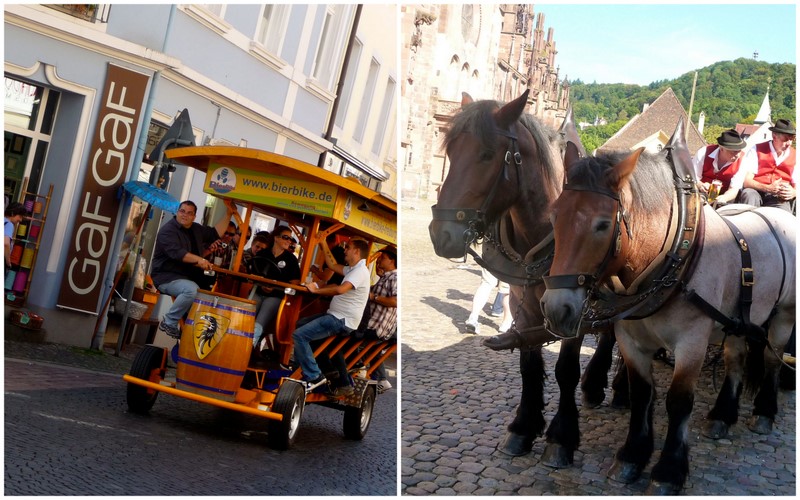
Freiburg now has the full complement of modern transport options, including some lovely trams.  However it also boasts a couple of more unusual and older ways of getting around the place.  Consumption of lots of beer seems to be an obligatory part of at least one of these options.
Much of the charm of Freiburg comes from the surviving examples from its past.  Like many medieval towns, Freiburg had fortified gates into the old town.  Two of them survive in very good condition.
The pavements of Freiburg were most interesting.  Many of them were covered with intricate mosaics.  Most of them represented the shop or business in the building beside the mosaic, though some just seemed to be decorative.  I loved them all.  Here are a few.
Also at street level were the gutters which crisscrossed the town.  They all had running water in them and most were in good condition, free from litter and other detritus.  They are clearly a tourist attraction for children as you could buy specially made little boats to pull through the water.  Alessio found this great fun.
 All in all Freiburg was a wonderful place to visit.   We were blessed with lovely warm sunny weather, which always helps.  However Freiburg was just a delight.  The cafés and restaurants were all very enticing and the ones we sampled excellent both in service and food.  Freiburg is also very lively place with throngs of people strolling about or just sitting in the sunshine supping a coffee or a beer.  There were also plenty of street entertainment to keep everyone amused, as with this pretty juggler.
On the Sunday afternoon as we drove back to Zürich we had two more adventures.  The first was one of these totally unexpected pleasures, when you by chance come across something delightful.  In this case we happened to drive past a little apple festival in the Elzacher valley.   A traditional brass band was on hand to provide musical accompaniment to the many guests who were happily gorging themselves on an irresistible selection of local goodies.   Though the main excuse was to celebrate the range of products from the humble apple, other fruit products were on sale.  A very popular liquid refreshment was a glass of Sekt, the German version of champagne, doused with a little fruit syrup.  There was a great range to choose from and all looked good.  We managed to try a couple each and bought some bottles to try out back home.   The festival was also an opportunity to see some of the traditional presses that used to be used in extracting the juice from apples.  Below is a collage from the festival.
Our next stop was the Black Forest Open Air Museum Vogtsbauernhof which is near Gutach.  Emma had found out about this museum on the internet and thought it would be interesting to Alessio.   It is in fact a wonderful museum.  A collection of original farm buildings from all over the Black Forest which have been lovingly moved and restored to their former glory in the Vogtsbauernhof.  Some of the buildings are very large and impressive, like the one below.
Inside each building you can see the actual implements used in the past, and in some cases the living quarters of the people who lived on the land.  There is also a fine collection of farmyard animals.  The collage below shows some of them.
Unfortunately Alessio was not particularly impressed with all this history.  Luckily there was an extensive playground for children, so he will probably have fond memories of his visit.  For the rest of us there was so much to see and do.  If we had more time we could have made our own scarcrow.  Kathleen was particularly keen on this.  There were also some living examples of traditional costumes to admire, as can be seen in the photos below.

This was our first trip to the Black Forest and most enjoyable it was.  We did have glorious weather.  However everyone we met was very helpful and kind, and everyone seemed to be pretty happy with life and enjoying themselves.  There is so much more to see and do in the Black Forest, it is a walker's paradise for example, that I hope to return again.

Thursday, 11 November 2010

Photo of the Month - October

October was the first month for some time that we have spent entirely in and around Dundee.  Though we did have a lovely visit from Emma and Alessio to keep us on our toes.  As usual when they are over here, we tend to do a bit more in the way of little trips.  The photos this month reflect this.  First up is this lovely autumnal display from the courtyard of St. Mary's Church in St. Andrews.  This is the Anglican church in the town and a beautiful building.
The next photo is of a sleeping beauty, taken while he was resting during his visit to the Blue Seaway playpark in Monifieth.
The following two photos were taken during out visit to the Deer Centre in North East Fife.  They have a wide selection of different types of deer on display.  The deer in the first photo is a reindeer.  The centre doesn't just host deer, and the second photo shows a magnificent example of the Highland cattle breed.  This is definitely the photo of the month.  Wonderful creature.

Next up are some photos from our little walk in Tentsmuir.  We walked on the edge of the forest and through some dunes and back along the shore.  This fine clump of fungi was found by the path along the edge of the forest.
We then have two photos of our grandsons.  First is this delightful one of Jamie and Alessio in a lovely cuddle.  The second shows all three.  Every time I tried to get a photo of all of them they would go into some pose or other.  This was one of the more interesting.

This photo was also taken on the Tentsmuir outing.  It shows an almost waterless estuary, looking across to Broughty Ferry.  Just shows how far the tide goes out hereabouts.
The next two photos were taken outside our house.   The first shows part of a display of plants, natural objects and ornaments which lies just beside the front door.  In the second you can just make out a little bird resting on a branch of a tree in our neighbour's garden.  The leaves have all gone from the trees by now. 

The final photo is a fine specimen of a scarecrow, which can be found in the gardens of Kellie Castle in the East Neuk of Fife.  The gardens are now organic and they preserve some rare specimens of vegetables.  Plenty of flowering plants as well and the Castle and gardens are well worth a visit.  Part of the National Trust for Scotland.

Monday, 8 November 2010

Campaigning against the cuts?

One of the most surprising things about the current political situation in the UK is the absence of any effective mass campaign against the economic and social policies of the Coalition.  No matter how nasty they are, there seems to be no willingness on the part of the general public to make their opposition loud and clear.  Opposition and anger there is, but so far very little in the way of public demonstrations.  Nothing like the strikes and demonstrations in Greece and France.  Nor any new political movement such as the Tea Party in the USA.
What’s up?  As I see it, there seems to be two explanations for the lack of any mass resistance.  In the first place the cuts and the economic thinking behind the cuts are widely seen as either inevitable or at least necessary.  All the main UK political parties advocated severe cuts in public spending.  They only differed over the speed of the cuts.  In addition all the mainstream media outlets have constantly banged on about the economic crisis and the absolute need for deep cuts in public spending.   Finally the main global  economic and financial institutions - IMF, OECD, the World Bank - also support urgent austerity measures.  
Thus the writings of the many distinguished and respected economists, of both the right and the left, who have exposed the shoddy economics behind this dash to cut, are rarely heard in the mainstream media.  All we ever hear or read about is endless debated about what to cut and by how much.  The Labour party, now in opposition, should of course be leading the fight against this economic madness.  But of course since Labour in government argued for severe cuts, they can hardly do a somersault and now argue the opposite.  Especially since the majority of Labour MPs still seem to think that deep cuts in public spending is the answer.  Must be a pretty silly question if that is the answer.
The result however is that there has been no sustained challenge to the  dominant neo-liberal nonsense about an economy in crisis and on the verge of collapse.  It is therefore hardly surprising that there has been a reluctant acceptance by the general public of the cuts agenda.  
The other significant factor in all this is that so far there have been few actual cuts and probably even fewer job losses.  The Coalition has played their hand very well in this respect.  There have been lots of announcements and headline figures of huge cuts in public spending.  But as yet the axe has only grazed a bit here and there.  First of all the cuts will be phased in over the next four years, thus lessening the immediate impact.  Secondly most of the actual decisions on what to cut will be left to others.  In particular it will be local authorities who will have to balance the books.  This of course means that many people will blame their local council instead of the Coalition.  And here in Scotland most of the cuts come in the form of a reduction in the block grant.  So it will be the Scottish government which has to take the first decisions on what to cut.  Then will come the turn of the local councils.  The Coalition clearly hope that with all these actors involved, at some of the blame will attach to them, letting the Coalition off the hook.
At the moment the political situation is a bit like the phoney war at the start of World War 11.  We all something nasty is coming, but no-one knows for sure just what it will look like and when it will all start to get really bad.  This of course makes campaigning against the Coalition very difficult.  In this respect I am not sure that focussing on opposing the cuts is the right strategy.  As explained above most people, unfortunately, accept that cuts are necessary.  It is also difficult to get people fired up about opposing a generalised threat of cuts in public services.  Again, unfortunately, there will always be people who are in favour of cutting some public services.  I, for example, would be most happy to see a steep cut our defence budget.  It can also, and will be, portrayed as special pleading.  And in general terms, by focussing on resisting all cuts, you are left open to the question of well, what would you do to get us out of the economic crisis?  
This in a way gets us back  to the beginning of this post.  More than just opposing cuts, we need to find a way to challenge the whole neo-liberal charade about the economy.  No easy answers to this I’m afraid.  I would suggest that campaigning should focus as much as possible on how we got into this economic and financial mess and in particular who got us all into the mess.  Make the bankers pay!  might make a good slogan.  There is a lot of anger out there and it is this anger against the big banks and the whole parasitical financial sector, and their political lackeys that campaigns should highlight.  Unfortunately this will have to be done without the active support of any of the main UK political parties.  In fact all of them will be terrified of such a campaign as all of them are to some extent guilty.

Thursday, 4 November 2010

The Reluctant Fundamentalist

The Reluctant Fundamentalist by Mohsin Hamid was the Reading Group’s book for October.  I had previously listened to the novel as an audiobook, but decided to take advantage of this opportunity to experience it as a novel to be read.  I enjoyed both versions and as is often the case gained more from the second reading.  The Reluctant Fundamentalist is a deceptively simple little book.  But a lot happens in its 200 or so pages.
At one level this is a simple tale of how one well educated Muslim was at first seduced by everything American and then gradually came to reject the USA.  The Muslim in question is Changez, the narrator of the novel.  He is from Pakistan and managed to gain entry into Princetown University, one of the most prestigious and elitist universities in the USA.  There he graduates as one of the best and the brightest and immediately succeeds in getting a job with a firm of valuators.  All goes well at first, but after the attacks on 9/11, things begin to change.  Changez notices a change in the way Americans regard Muslims, and Changez himself begins to change his views about his work and about the USA.  Eventually he leaves his job and the USA and returns to Pakistan where he finds a job as a university lecturer.
This is the bare bones of the novel, though one of its many delights is the telling of the tale.  The whole novel is written as a conversation between Changez and an unnamed and unknown American.  They meet in the old part of Lahore, Changez’s home city.  The opening line is: “Excuse me, sir, but may I be of assistance?”   The rest of the novel is Changez’s conversation with this person, though we never hear him speak.  We only hear Changez’s side of the conversation.  A most intriguing device and as the day unfolds the tension rises as their conversation reaches its enigmatic conclusion.
The title of the novel is of course hardly an accidental choice.  What is fascinating is that in the novel the word fundamental is only used to describe the work of the valuating firm that Changez works for.  Their job is to examine the finances of companies over the world and seek out the fundamentals of the business.  In other words which bits, if any, can be made to make lots of money for their investors - irrespective of the social and personal damages this will cause.  Post 9\11 Changez comes to question the value of this work, especially in light of the way the USA mistreats Muslim countries.  The key turning point is reached when he is accused of being a modern day Janissary by a bookstore owner in Chile.  The Janissaries were young boys from Christian families who were taken from their families and brought up as Muslim soldiers whose sole duty was to protect the Ottoman Sultan.  They could only do this because they knew nothing about their own culture and peoples.  Changez comes to realize that in his current job he too has rejected his family and his Pakistani culture.  All to further the USA in its War of Terror against Muslim countries.
The novel can also be read as a more explicit allegory.  This seems to be the main explanation for the inclusion of Erica and Chris in the story.  Erica is a beautiful, but emotionally fragile young woman whom Changez meets as a student.  He falls in love with her, but she remains aloof most of the time and in time suffers a breakdown.  This is due to the death of her boyfriend Chris.  She never recovers from this loss, despite Changez’s best efforts to help her.  At one level a simple tale of rejected love, the key to this part of the novel is the names of the characters.  Erica can be regarded as representing America, as Erica is America, minus the first two letters Am.  While Chris, who never appears in the novel, can be seen as an amalgam of Christopher Colombus and Christ.  Chris thus represents traditional America -  white, European and Christian.  Into this comes Changez, whose name is the Urdu version of Genghis of Genghis Khan fame and notoriety.  The English spelling of the name of course makes it represent change.  So Changez can be seen to represent the prospect of a new virile future.  A future which of course Erica rejects, trapped as she is in the nostalgia of the past.
However you read the novel there is much to enjoy and appreciate.  And to think about.  For that is the real strength of the book.  It asks us to reconsider who are the real fundamentalists?

Monday, 1 November 2010

Three Cheers for Multiculturalism

This post has been inspired by the recent comments from Germany’s Chancellor, Angela Merkel.  Speaking to members of her own party (CDU) she asserted that, “multiculturalism has failed, utterly failed.”   In making this claim she seems to have a very limited understanding of what multiculturalism is about.  She said that allowing people of different cultural backgrounds to live side by side without integrating had not worked.  She then went on to say that this (multicultural) approach has failed.  This would seem to suggest that it is the failure of immigrants to integrate which has caused the failure of multiculturalism.
However by focusing solely on the demand that immigrants integrate, she clearly implies that the host nation and population do not need to do anything.  As usual blame the victims.  In another part of her speech she lets the cat out of the bag when she added: "We kidded ourselves a while, we said: 'They won't stay, sometime they will be gone', but this isn't reality."  As an outsider it seems to me that this is precisely the key to the particular difficulties now faced by those countries such as Germany which treated immigration as only a temporary phenomenon.
The workers and their families who came to Germany from the 1960s onwards were always referred to as Guest Workers.  People who would sooner or later go back home.  Thus there was never any expectation or requirement that they integrate into German society.  Why should Turkish immigrants go to all the bother of learning German and German customs if they were only here as temporary Guests?  And, most important of all, why would the German authorities, whether Federal, Land or local, spend good taxpayers money on helping those temporary guests integrate.  
To the extent that integration is crucial to the success of multiculturalism, then it must always be borne in mind that integration is a two way process.  While the immigrant population can be legitimately expected to learn the language and main customs of the host country, the host population has to be willing to accept the new arrivals as future citizens with welcoming arms.   And this is what does not seem to be happened in Germany, at least not in the early decades of immigration.  Angela Merkel would be better to look at the failures of Germany policy towards the immigrant Turkish community rather than blaming the immigrants.
This is not of course an important issue only in Germany.  All European countries have had problems in welcoming immigrants.  Scotland and the UK as a whole has had some terrible experiences in the past in failing to integrate immigrants.  Jews, East Europeans have all suffered from discrimination and violence from the local population.  In Scotland the most notable victims of this hostility to immigrants were the Irish who came to live and work in Scotland (and other parts of the UK) in the 19th century.  What is most interesting about this group was that the Irish were fellow citizens of the UK at that time, and in their majority spoke English.  Yet they still suffered great hostility and discrimination.  In part this was because they were seen as a threat to jobs and houses and so on.  The standard accusation thrown at all immigrants.  But what stood out in the hostility to the Irish immigrants was that they were Catholic.  Scotland at that time was an overwhelmingly Protestant country and many, perhaps most, Scots had a very strong dislike, verging on hatred of Catholicism.  This hostility and remnants of discrimination was to survive into the 1960s.  Thankfully it is now pretty much reduced to the mutual loathing between the football supporters of Rangers and Celtic.  Indeed in the past three decades there have been two very successful Papal visits to Scotland.  Something that would have been unimaginable only 50 years ago.
Returning to Germany and this notion that multiculturalism has failed as a result of the lack of integration by the immigrant community.  I would suggest that the experience of the Irish in Scotland and the rest of the UK, shows that integration is not the key issue at all.  The Irish immigrants were UK citizens and spoke English.  It was their religious differences that generated the hostility.  Then the victims were Catholics.   While now of course, in Germany as in most other European countries it is Muslim immigrants who face the brunt of popular hostility. 
In the long run these conflicts tend to die out.  In Scotland for example there is a large and flourishing Catholic community well integrated into all aspects of Scottish society, yet still Catholic and predominantly of Irish origin.  Likewise there are smaller, but equally flourishing Jewish, Hindu and Muslim communities throughout Scotland.  All continue to make Scotland a more attractive and interesting place in which to live.  The long run can however be a long time a’coming and meanwhile great damage can be done.  If integration is to be promoted then more Europeans need to welcome Muslims as fellow citizens and integration will follow.

Thursday, 28 October 2010

My Favourite Operas

Opera is probably my favourite among the performing arts.  I like pretty much all performing arts, but opera has that something extra.  What is it about opera then?  Well in opera you can get just about everything.  Orchestral music, singing, acting, weird and wonderful sets and costumes and  with luck, as an added bonus some ballet.  What more could anyone ask for?
But what makes for great opera?  First up must be the music.  It is after all the composer’s name that is most often associated with an opera.    The appeal of the music is primarily the vocal writing.  Just about anything the human voice can produce can be found in an opera - arias, duets, ensembles, chorus and more no doubt.  Some famous operas survive primarily or even solely due to the magic of the music.  The Pearl Fishers by Bizet springs to find.  An opera best known for its wonderful all male duet - Au fond du temple saint.
However there has to be more than just the music.  Otherwise we could just go to the concert hall.   What makes opera different is that there is to a greater or lesser extent some dramatic content.  Though the drama is vital to a great opera, it is still the quality of the music that makes the difference.  While a poor drama with great music will survive in some form or another, good drama with crap music will not survive.  Or if it does, it will survive as drama alone.  What makes great opera so special is this almost perfect marriage between drama and music.  Opera is, after all is said and done, a form of music theatre.
In working out which are my top ten favourite operas I find that all have their basis in the strength of the underlying story or drama.  While great music is always worth hearing on its own, a great opera needs to be based on good theatre.  
It is thus no surprise that two of my favourites are more or less straight adaptations of successful stage plays by Beaumarchais, while another two are based on plays by Shakespeare.  Three others were intimate collaborations between playwright and composer.  All my favourites make for compelling music theatre with wonderful music.
A little word about some operas not on my list, as they include some which I love dearly.  First up of course, this is my top ten.  For reasons of space, I decided to limit myself to ten operas.  As with any such list the merits of operas just outwith these ten are only marginally less than those in the listed ten.  Secondly I prefer operas that are not too long, however wonderful the music.  This does work against Wagner in particular, though I have included Die Meistersinger, where the comic elements help propel the action on stage a bit more than in some of his other wonderful operas.   Anyway here is the list of my very own favourite operas.


  1. Le Nozze di Figaro                          Wolfgang Mozart
  2. Carmen                                             Georges Bizet
  3. Falstaff                                              Giuseppe Verdi
  4. Otello                                                 Giuseppe Verdi
  5. Die Zauberflöte                                Wolfgang Mozart
  6. Des Contes d’Hoffmann                Jacques Offenbach
  7. Il Barbiere di Siviglia                       Gioachino Rossini
  8. Die Meistersinger                            Richard Wagner
  9. Der Rosenkavalier                           Richard Strauss
  10. Turandot                                           Giacomo Puccini

Monday, 25 October 2010

Coalition speaks with forked tongues!

So our masters in the Coalition government have finally revealed the extent of the damage they intend to inflict on the rest of us.  On the whole it is pretty much as expected.  Here are my initial thoughts on some of the key issues about the proposals.  One thing that stands out is that not only is the Coalition nasty, but they also tell lies and lots of them.  Let’s have a look.
  1. The first lie is the claim that the cuts are “fair” and that the poorest in society have been somehow protected.  It only took the Institute of Fiscal Studies (IFS) four hours to burst that claim.  Further research shows beyond doubt that the Coalition were lying and presumably knowingly lying when they made that claim.  It is quite incredible when you think that the biggest cuts are to come in the benefits budget - so clearly the poorest are going to suffer the most.
  2. Linked to the lie about fairness is the claim that “we are all in this together”.  This is a particularly galling lie coming from a government stuffed with multi- millionaires from a highly privileged background.  It would be fascinating to know just exactly what the likes of Cameron, Osborne, Clegg and co. are going to have to give up to help reduce the deficit.  At the same time we hear that the government’s friends in the City are to share bonuses of £7 billion this year.  So just who is in this together?  Certainly not the government or the very rich or the City financiers.
  3. Talking of banks and their willingness to share the pain of the mess.  A mess that they - the financial companies created.  The government announces that they will introduce a levy on the banks, but it is only expected to raise £2.5 billion a year.  Why only £2.5 billion?   Well, we can’t raise more or otherwise the banks would leave the UK and set up shop elsewhere.  So much for solidarity.   And in fact due to the progressive reduction in corporation tax, most banks will end up paying nothing at all in additional tax.  Now, where is the outrage against these threats by the banks to up and leave.  If Trade Unions make any kind of threat to take industrial action the government and their friends in the media immediately accuse workers of holding the country to ransom.  Is this not exactly what the City is doing?  Their threats, if true are a form of treachery.  So why are these banks and financial companies not named and shamed?  And just where would they go?  This is all another example of lies from the government.  They won’t increase tax on the banks because they don’t want to - too many friends in the business as it were.
  4. Of course there is no need to worry about any of this.  The Free Market is going to step in solve all our woes.  If you believe this then you do believe in fairies.  Most economist look for a bit in the way of evidence.  As Danny Blanchflower, former member of the Bank of England’s Monetary Policy Committee wrote for the Guardian,  “The Chancellor’s economic strategy is to cross his fingers and hope that the private sector will create 2.5m jobs within five years, despite the fact that between 2000 and 2008 only 1.6m private sector jobs were created. Recovery is going to be a long slog.  Contrary to claims made by various members of the government, there is no believable evidence that fiscal tightening on the scale that is being proposed has ever worked. When Canada implemented its fiscal tightening its neighbour was experiencing the Clinton boom, plus it was able to cut interest rates.”  You can read the whole article here.  And remember that letter signed by 35 so-called leading businessmen urging on the cuts and assuring everyone that the private sector will be able to make up the job losses in the public sector?  Well it turns out that most of the signatories were also lying.  Most of the companies involved have been shedding jobs over the past two years and some have privately informed their boards that they are most unlikely to take in new staff any time soon.  All because of the austerity measures imposed by the government.  Seems it is not only the government we can’t trust.  We can’t trust business leaders either.  So nothing new there!  Osama Saeed has some details here.
  5. Finally we come to the grandaddy of all the lies.  The one about we had to do it guv.  Things were in such a mess and the country was on the brink of bankruptcy that we had to take drastic action or the whole world would have punished us.  Or at least the markets would have punished us with higher interest rates on our debt.  This is all a pack of lies and well documented lies at that.  The key points to bear in mind are the following.  1. the current level of government debt is not that high historically.  Between 1920 and 1960 government never fell below 100% of GDP.  Yet we all managed to survive.  2.  current government debt is not high in comparison with other countries.  In fact the UK has the lowest level of government debt as a proportion of GDP among the G7 countries.  3.  the government debt is overwhelmingly owed to UK institutions and is also long term and not due to be repaid for another 10 - 12 years.  This means there is no threat to our credit rating by the foreign money markets.  You can read more about these particular lies here, here and here.
What is most depressing about all this is not simply that our Coalition government is both nasty and lying, but that the level of coverage in our mainstream media is so pathetic.  The odd critic is allowed to raise his or her objections but the overwhelming attitude of both the print and TV media is to accept at face value the government’s line that there is no alternative to cuts - it’s just a matter of how much and how fast.  This of course makes Labour’s opposition so difficult.  They also are thirled to the basic (false) premise.  We are trapped in a situation in which virtually all our MPs, with one or two honourable exceptions, all agree with the conventional wisdom.  So much for our much lauded democracy.  
For the future we need to not just oppose the cuts, but to begin to develop an alternative economic vision.  Can Labour provide us with this?  Now, now, you don’t believe in magic fairies do you?  As a starter for ten here is a good introduction to just how stupid the conventional wisdom is.