Showing posts with label books. Show all posts

Thursday, 17 November 2011

Recent Reads - November 2011

I have been quite busy reading wise recently and have managed to include some new authors this time around.  I am currently reading El Enigma de París by Pablo de Santis.  This is my second book in the Ficciones Argentina Reading Challenge.  El Enigma is a crime novel, but rather unusual in that it features 12 Detectives.  They form an elite group of detectives from all over the world and meet up in Paris 1898 for the Great Exhibition.  Their founder, from Buenos Aires, cannot attend and sends his young assistant instead.  It is this assistant who narrates the events.  It is beginning to get very interesting as one of the detectives has been found dead at the bottom of the Eiffel Tower.  Who dunnit?
As usual my list includes a good number of crime novels.  One was by a new author for me - Johan Theorin who wrote Echoes from the Dead.  Theorin is from Sweden and this is his first novel which is set in the island of Öland off the east coast of the country.  It is a very sad and dark tale about the re-opening of the case of a young boy who went missing twenty years earlier.
A Death in Calabria by Michele Giuttari is the third crime novel I have now read by this Italian writer.  The first was A Florentine Death, followed by The Death of a Mafia Don.  All in fact heavily feature the mafia, though in A Death in Calabria it is the local variety - the ‘Ndrangheta.  Very matter-of-factly and sparsely written they are all terrific reads.  A common thread is provided by Chief Superintendent Michele Ferrara who leads the investigations in all three books
Death of a Red Heroine is the second book I have read by Qiu Xiaolong, a Chinese writer who now lives in the USA.  This is in fact the first in the series which features Inspector Chan of the Shanghai police.  Here he has to find out who murdered a beautiful national model worker.  This brings him into conflict with the higher echelons of the party.  Set in 1990 this is not just a good crime mystery but a good insight into the recent history of China.  
I have also managed to sneak in a couple of audio versions of crime novels.  The first was About Face by Donna Leon, another in the Comisario Brunetti series.  Though set in Venice, this tale spreads far and wide and has some similarities with A Death in Calabria.  Once again the mafia are involved as is the illegal trafficking of toxic waste.  The other audio novel was Dark Water by Caro Ramsay.  Another very dark tale of murders most foul.  Not to mention a bit of police infighting.  Gripping and atmospheric and very well read by James MacPherson, who does a mean Liverpool accent.
Though crime as usual dominates, I did manage to read a couple of other novels.  All were by new authors to me.  The Coffee Trader by David Luss is set in Amsterdam in the mid 1600s and though the newly developing coffee trade is the background for the tale it is about a lot more.  The greed, gambling and corruption at the heart of the stock exchange reads like a pretty good description of what happens today.  The novel also touches on the complex relationships both within the Jewish community in Amsterdam and elsewhere and their relationships with non Jews.  The heart of the story though is about trust and betrayal.  
Pereira Maintains by Antonio Tabucchi.  This was published in Italy in 1994, though the story is set in Lisbon in 1938.  Portugal is now a dictatorship run by Salazar, while Spain is in the throes of its civil war.  Pereira is an elderly apolitical journalist who edits a literary supplement for a low circulation newspaper.  Not wanting to get involved in anything his life is changed by a chance meeting with a young man and the man’s girl friend.  Gradually Pereira grows in awareness of the ugly and murderous reality of the regime in Portugal.  The novel slowly builds up to an unexpected climax.  Great atmospheric descriptions of Lisbon and life in a dictatorship.
I listened to the audio version of The Eye of Jade by Diane Wei Liang.  Like Qiu Xiaolong, Liang is a Chinese writer who now lives in the USA.  This novel is set mainly in Beijing in the year before the uprising at  Tiananmen Square.  The main character is Mei a private detective.  Though she does work on a case, this is not really a crime novel.  Though there are plenty of crimes.  However the crimes have more to do with recent Chinese history and the cultural revolution than anything else.  The novel is mainly about Mei’s attempts to find out what really happened to her father, who was sent to a labour camp, where he died.  Who sent him there and why?  The book also deals with Mei’s difficult relationship with her mother and younger sister.  Ultimately a rather sad and poignant tale, with no happy ending.

Monday, 24 October 2011

A is for Jane Austen

This is the first post in what I hope will be an A-Z of my favourite writers.  Jane Austen is not just first on the list, but without a doubt one of my all time favourite authors.  I’ve read all of her novels, most more than once.  And enjoyed them all apart from her early attempt at Gothic horror - Northanger Abbey. 
What I find most alluring is her use of language.  Not just the famous use of irony, but the way she is able to turn a simple description or tale into a work of beauty.  It is just a great pleasure to read any of her works.  Here for example is the first sentence of Emma, where the little word seemed changes what is an apparent glowing tribute to the novel’s heroine into something like its opposite.  “Emma Woodhouse, handsome, clever, and rich, with a comfortable home and happy disposition, seemed to unite some of the best blessings of existence; and had lived nearly twenty-one years in the world with very little to distress or vex her.”
Another example of her art of using a character’s good points to expose that person’s worst aspects comes in Persuasion with this delightful and deadly character assassination of Walter Elliot.  “Vanity was the beginning and the end of Sir Walter Elliot's character; vanity of person and of situation. He had been remarkably handsome in his youth; and, at fifty-four, was still a very fine man. Few women could think more of their personal appearance than he did, nor could the valet of any new made lord be more delighted with the place he held in society. He considered the blessing of beauty as inferior only to the blessing of a baronetcy; and the Sir Walter Elliot, who united these gifts, was the constant object of his warmest respect and devotion.”
The main complaint I have about her novels is that they contain a few too many stock, comic characters that stretch the imagination to believe in.  Emma’s father for example or Mrs Bennet in Pride and Prejudice.  Perhaps there were real people like them in Austen’s time.  For another of her strengths is that her novels are very much set in a particular place and time.  Nobody seriously challenges the existing order.  While her novels all feature very strong and powerful women characters, they all succeed within the existing social norms.  A good marriage and a reliable income was the sine qua non for a contented life.  Not much has really changed.
There are now so many editions of her novels available, that a reader faces an embarrassment of riches.  If you don’t want to buy a book and are happy to read from your computer screen austen.com has all her works available online for free.
Jane Austen’s works have proved very popular with film makers, both for the big screen and TV.  One of the most successful and critically acclaimed productions was the 1995 TV adaptation with Jennifer Ehle and Colin Firth in the main roles.  With six one hour episodes this mini series managed to include most of the novel’s key scenes.  
Of the film adaptations my favourite is definitely Sense and Sensibility.  And there are two fine versions to cherish.  The more well known is the 1996 version directed by Ang Lee with a screenplay by Emma Thompson, who also starred in the film alongside Kate Winslet, Hugh Grant and Alan Rickman.  

For something less well know and completely different I would recommend Kandukondain Kandukondain (2000), the Tamil language film.  Also known as I Have Found It, this wonderful Bollywood type film is a sheer joy to watch.  Directed by Rajiv Menon who wrote the screenplay along with Sujatha.  The film stars Aishwarya Rai, Tabu, Mommootty and Ajith Kumar with music by A R Rahman.  This version of Sense and Sensibility sets the action in modern day Tamil Nadu.  It works wonderfully well and the music and dance sequences are a joy to behold and hear.  If you do get a hold of a copy watch out for the song and dance sequence filmed at our very own Eilean Donan Castle in western Scotland.  To whet your appetite you can see this for yourself here.

Monday, 17 October 2011

Take Six Books - October 2011

I have changed this to Six Books as I have recently bought some books.  Though I have decided to keep with an audiobook.  So here is my current crop of books.
The book I’m currently reading - Brighton Rock by Graham Green.  This is the reading group’s choice for the month.  I’ve never read it before, neither have I seen either of the film versions.  So I was quite surprised by the novel.  Not at all what I expected.  It is a darkly funny tale at times and betrays Greene catholicism or at least its obsession with sex, guilt and death.  Very enjoyable.
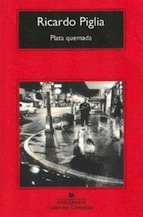
The last book I finished - Plata Quemada by Ricardo Piglia.  At last I have got round to reading something for the Ficciones Argentinian reading challenge.  Based on a true bank robbery in the 1960s in Buenos Aires.  Not a traditional crime novel in any sense, as we know from the beginning who did it and also know more or less how it ends.  However instead Piglia takes us inside the minds of the main characters and a pretty weird, violent and unattractive place this is.  Good book.
The next book I want to read -  Echoes from the Dead by JohanTheorin.  This is part of my gradual exploration of new Scandinavian writers.  Theorin is from Sweden and this is his first novel.  It is set in the island of Öland off the east coast of the country.  All about a young boy who went missing some time ago.
The last audiobook I listened to - The Gallow’s Bird by Camilla Läckberg.  This is the fourth of Läckberg’s novels I have listened to and all have been very enjoyable.  Läckberg is another Swedish crime writer, and The Gallow’s Bird, like the others, is set in a small town on the west coast of Sweden.  As with the others in the series this is as much about the personal lives of the detectives as the actual murders.  A pretty chilling tale though.

The last book I was given -  Willing Flesh by Adam Creed.  This will be a new one for me, as I have never come across the author before.  Creed is an English writer and this is the second of his novels to feature Detective Inspector Staffe.

The last book I bought - To the Ends of the Earth by T. M Devine.  A rare occurrence for me - buying a book!  Professor Devine’s book is the history of Scotland’s global diaspora as the subtitle puts it.  It has had some great reviews and the man himself came to Dundee to give a talk about the book.  So I just had to get a copy.  This is one book I will take my time to read.  One to dip into and return to.

Sunday, 25 September 2011

Reading Challenges 2011 - Update

At the beginning of the year I wrote a post about Reading Challenges and this post is an update on my progress so far.  I have formally signed up for one just the one challenge - the East European Reading Challenge.  I didn’t specify the level, but as I have now read six books from Eastern Europe, I have already passed the tourist level, (four books) and need another two to reach the Amabassador status.  Which I will try to do between now and the end of the year.
The books have been a bit of a mixture.  I started with Boris Akunin and his Erast Fandorin series of crime novels.  Both The Turkish Gambit and The Winter Queen are set in the 1870s and are not your typical crime novel.  They tend to go at a rather leisurely pace and are full of strange and unusual characters.  They also give us a good idea of the world view of (probably) most Russians, not just then, but as of to-day.  Well worth trying out.
I followed up with two of the great classics of not just Russian, but world literature - Crime and Punishment by Fyodor Dostoyevsky, and War and Peace by Leo Tolstoy.  Not much to add about either book.  Both are wonderful creations, though very much on the long side.
Since then I have dipped into post Yugoslav literature.  Death of the Little Match Girl is by Croatian writer Zoran Ferić, while The Tiger’s Wife is by Serbian author Tea Obreht.  Ferić writes in Croatian, while Obreht, who left Serbia as a child, writes in English and now lives in the USA.  Book books are rather strange and unsettling affairs.  Not surprising as both deal, in an offstage kind of way with the wars that followed the break up of Yugoslavia.  Interesting and on the whole successful attempts at story telling.  I now need to find two more books from Eastern Europe.
In addition to the Eastern European Challenge I set myself some non formal challenges of my own for the year.  I had hoped to dip into Japanese literature again but so far I have not managed one.  I have however read three books about China which would qualify me for the Merchant level in The Chinese Literature Challenge.  Two are by Chinese women writers who now live in the West and both deal with the travails of growing up in China.  Falling Leaves by Adeline Yen Mah is the author’s personal story of her and her family’s life in both pre and post revolutionary China and then subsequently in the USA.  She had a pretty unhappy childhood as she was actively disliked by her stepmother.  Miss Chopsticks by Xinran is an altogether more upbeat and light hearted tale of how young peasant women are beginning to empower themselves in the new China.  River of Smoke by Amitav Ghosh is the second part of the Bengali writer’s trilogy set in the 1830s.  As most of the action in this novel takes place in and around Canton it qualifies for the Chinese Challenge.  River of Smoke is a great book about the interaction between Chinese and foreigners at the time of the 1st Opium War.  I have also read one other book by an Asian writer.  The Calligrapher’s Daughter by Eugenia Kim is set in Korea and vividly describes life in that country before and during the Japanese occupation.  This means that I have also made it for the East and South East Asia Challenge, as I can count two of the previously mentioned books for this challenge.
Another of my informal challenges was to continue reading lots of Scandinavian crime novels.  In particular I wanted to finish the Jo Nesbø series.  This I have managed to do quite easily and very enjoyably.  Just about everything I read from Scandinavia is very, very good.  I am now up-to-date with Jo Nesbø’s works.  Luckily I have come across a writer new to me - Mari Jungstedt from Sweden who writes about a detective based on the Baltic island of Gotland.  So far I have read one of this series, The Death of Summer and very good it was too.
Reading some books in German was another personal challenge and I have stubbornly stuck to it.  I say stubbornly as it is not at all easy for me to read books written in German.  But with the help of the dictionary I usually manage to get through.  So far I have read three books in German, two by Swiss writers - Die Haushälterin by Jens Petersen, a tender tale about the fraught relationship between a teenager and his widowed father; and Silberkiesel, a crime novel set in Basel, by Hansjörg Schneider.   The third was another krimi by Austrian writer Heinrich Steinfest.

I also planned to read more books in Spanish this year.  The challenge was to read one each month.   This I have not managed to do, partly because I have interspersed Spanish language books with German language books.  Nevertheless I have read four books in Spanish.  All of them crime novels and all very good.  In order of reading they were:  Un Crimen Imperfecto, by Teresa Solanas;  Ojos de Agua by Domingo Villar:  Ritos de Muerte by Alicia Gimenez Bartlett and Dulce Amor a Muerte by Guillermo Arriaga.  The first three are by Spanish writers, while the last is by a Mexican author.  As part of my Spanish language challenge I intend to sign up for another challenge - the Argentina Reading Challenge.  I hope to achieve the Student level, which requires me to read three books by Argentinian authors.  I now have two such books, again both crime novels - Plata Quemada by Ricardo Piglia and El Enigma de París by Pablo De Santis.  This challenge ends in February 2012, so I have until then to find one more book by an Argentinian author.  Wish me luck.

Friday, 12 August 2011

Take Five Books - August 2011


Back to this five book challenge, originally devised by Simon at Stuck in a Book.  Once again I have included an audiobook.  So here is my current crop of books.
1. The book I’m currently reading - And the Land Lay Still by James Roberston.  This is an enthralling novel by the author of The Testament of Gideon Mack.  It is a very ambitious book which tries to describe and make sense of the history of Scotland since the 2nd World War.  He does this by focussing on a disparate group of characters whose lives at times meet and overlap.  At 670 largish pages it is an ambitious read in more ways than one.  Just started the fifth and final part, so await with fascination how he draws everything together - assuming he does.

2. The last book I finished - The Death of the Little Match Girl by Zoran Ferić.  This is a fairly short book, though pretty complicated for all that.  Set in an island off the coast of Croatia in 1992, during the violent and messy break-up of Yugoslavia, which serves as a background to the events.   A young girl dies of illness and a Romanian transvestite prostitute is murdered.  Is there any connection between the two deaths?  The novel can loosely be called a crime novel though it is much more as it brings out some of the nasty undercurrents of life in the latter years of Yugoslavia.

3. The next book I want to read -  Un Dulce Olor a Muerte by Guillermo Arriaga.  Mexican author Arriaga is most famous as a script writer for films, some of which, such as Amores Perros and Babel, have become internationally successful.  This book looks like a kind of revenge mystery.  It is also available in an English translation as A sweet scent of Death.

4. The last audiobook I listened to - The Dead of Summer by Mari Jugstedt.  This was my first encounter with Mari Jungstedt, another Scandinavian crime writer.  Is there no end to this phenomenon?   Anyway Jungstedt is Swedish and this is her fifth book to be set in the island of Gotland and to feature Inspector Knutas.  Similar in some ways to the writing of Camilla Läckberg, this murder mystery focuses as much on the characters, the police and the various suspects as on the crime itself.

5. The last book I was given -  In the Footsteps of Mr Kurtz  by Michela Wrong.  This is an account of the rise and fall of Mobutu Sese Seko, the former dictator of the Congo.  Last year I read another book about the Congo - Blood River by Tim Butcher.  This was an attempt to retrace the journey of H M Stanley as he sought to travel down the great Congo river.  The book was more about the country itself and I found it fascinating.  So I am greatly looking forward to finding out more about this troubled country.

Monday, 18 July 2011

River of Smoke by Amitav Ghosh

This is the second volume in what is expected to be a trilogy.  The first was Sea of Poppies which I have reviewed here.  Sea of Poppies ends with a dramatic escape at sea during a violent storm.  River of Smoke starts with the aftermath of that escape.  However this novel is very different from Sea of Poppies.  While we do learn about the fate of some of the main characters from the first novel, River of Smoke is more about new characters.  Like the Sea of Poppies there is some sense of adventure and sweep of movement as the action moves from Mauritius to Singapore and on to Canton, with a detour to Bombay.  But this time the focus is much more on one person and one place.
That person is Seth Bahramji Naurozi Modi, known as Bahram, and the place is Canton.  The year is still 1838.  Bahram, his current travails and his backstory, dominates the book.  He is a parsi, married into a wealthy and well established Bombay family.  Their main concern is ship building, but Bahram has branched out into the even more lucrative business of transporting and selling opium to China.  This trade is centred on the Chinese port of Canton and it is here that most of the action takes place.  This opium trade, though very lucrative is illegal.  It has only survived due to the connivance and corruption of local officials.  However all that is about to change as the Chinese imperial authorities set about to bring an end to the trade.  It is this bitter stand off which takes up most of the novel.
As with the Sea of Poppies, Amitav Ghosh has created a wonderful cast of characters for us.  Bahram of course, but many of the others are equally fascinating and colourful people.  They include Chi-Mei, his Chinese concubine and their illegitimate son Ah Fatt;  Zadig Karabedian, an Armenian merchant now based in Egypt;  Robin Chinnery, the illegitimate son of an English painter;  Fitcher, a plant collector from England and Paulette the young mamzelle from the earlier novel.  In addition there are the various characters who make up the foreign compound in Canton and their Chinese counterparts.
In addition to the personal histories and adventures of these characters, the novel describes in a dramatic way the disputes between the Chinese authorities and the foreign, mainly British opium merchants.  Ghosh mainly allows the representatives of the two sides to speak for themselves in a series of meetings between the Chinese and foreign merchants.  It is not a pretty tale as the British immediately request a resort to force - it is through the barrel of a sixteen pounder that free trade will come to China.  This is not a new story nor has it really ended, as can be seen in the military adventures of the UK and the USA to-day.  It is a major triumph of the book that amidst the adventures, romances and personal tragedies, Ghosh has managed to evoke the essence of Western imperialism in such a believable and dramatic way.  As one of the British merchants so prophetically puts it:  “After two centuries of commerce, it is impossible that we should abandon our factories and retreat from Canton.  It is here that we must make out stand;  we must show the Chinese that if they attempt to curtail foreign trade they will find their boasted power shaken to pieces.  Is it not time to ask what may be the consequences to this empire of the ignorance and obstinacy of its rulers?  Ignorance of everything beyond China, obstinate adherence to their own dogmas of government?  The answers are clear:  we must remain here, if for no other reason than only to protect the Chinese from themselves.  I do not doubt that it will soon become necessary for the British government to intervene here as it has elsewhere, merely in order to quell civil commotion.”  Plus ça change, plus c’est la même chose.

Wednesday, 29 June 2011

Take Five Books - June 2011


Thought I would have another go at this five book challenge, originally devised by Simon at Stuck in a Book.  This time I have had to change one of the headings.  As I don’t buy books that often, a bit of a skinflint, I have substituted an audio book instead, as I do listen to audiobooks a lot.  So here are my five books for June.
1. The book I’m currently reading - Brother of the More Famous Jack by Barbara Trapido.  This was the first book published by Barbara Trapido.  I have previously read, or rather listened to a latter novel, Sex and Stravinsky, which I enjoyed very much, though it had little to do with either sex or Stravinsky.   I also enjoyed Brother of the More Famous Jack which does feature of lot of sex.  It is on the whole a funny and witty little book which recounts one young woman’s sometimes painful journey towards maturity. 
2. The last book I finished - The Snowman by Jo Nesbø.  I am a great fan of Jo Nesbø, and this is now the fifth I have read, all featuring Oslo’s very own detective Harry Hole.  As with the others, The Snowman is about the solving of some pretty brutal and terrifying murders.  This time it gets really personal for Hole himself.  
3. The next book I want to read -  March Violets by Philip Kerr.  This is the first in Philip Kerr’s series of novels featuring detective Bernie Gunther.  I’ve read two of the latter novels which I thoroughly enjoyed, so I am now looking forward to going back to the beginning.  This one is set in Berlin in the 1930s with the Nazis in power.
4. The last audiobook I listened to - The Lemon Tree by Julian Barnes.   This was slightly unusual for me in that The Lemon Tree is a collection of short stories.  I enjoyed all 11 stories which are about aging, dying and reminiscing about the past, usually with bitterness and regret.  Well read by Timothy West and Prunella Scales.
5. The last book I was given - The Death of the Little Match Girl by Zoran Ferić.  Earlier in the year I signed up for the East European Reading Challenge.  So far I have only read books by Russian authors, so I have pinched this book from Elena, who has no time to finish it.  This will be another first for me - a Croatian writer.  It is billed as “bizarre, uncomfortable fusion of detective story, crime novel, political thriller, and raw, grotesque fiction.  In short - Balkan krimić.”  So no idea of what I have let myself in for.

Wednesday, 8 June 2011

When We Were Orphans, Kazuo Ishiguro


This was the Reading Group’s book for May and I was much looking forward to reading the novel.  I have previously enjoyed two of Ishiguro’s other works.  I listened to the audio version of Never Let Me Go and I also saw the film version.  Remains of the Day is of course a wonderful film.  So it was with great expectations that I started When We Were Orphans, particularly as this would be my first experience of reading one of Ishiguro’s novels.

It was alas a bit of a disappointment.  Though the novel starts with an interesting and promising idea the whole book is to my mind a great conceit on the part of Ishiguro.  Nothing in the novel or in the writing is ever what it appears at first sight to be.  Take the first part, which, like all the others is given a very precise place and date.  In this case, London, 24th July 1930.  However the first sentence begins – It was the summer of 1923…….  We are then almost immediately taken further back in time as the narrator recalls various incidents from his past, including a reference to his leaving Shanghai as a young orphan in the years before the 1st World War.  It is not until later on that we finally emerge in 1930.  A similar approach is taken with other parts of the novel.  Ishiguro clearly likes to play with time and with his narrator’s memories of time.  I suspect he also likes to play with us readers.

It is all beautifully done, as Ishiguro is a master of deliberate imprecision in his writing.  Here is an example of the convoluted way he allows the narrator to prepare us for an account of something that happened in the past.  – There was one other small incident from those weeks following my father’s disappearance which I have now come to believe highly significant.  I did not always regard it so; in fact, I had more or less forgotten it altogether when a few years ago, quite by chance, something happened which caused me not only to recall it again, but to appreciate for the first time the deeper implications of what I had witnessed that day. (p113)

There is much more very fine writing in the book, but what prevents it from working as a whole is that there is just too much variation in styles for no apparent purpose, other than to show off.  There is for example the intermittent use of an even then, old fashioned, upper class English of the stiff upper lip kind.  It even appears when the narrator is caught in the midst of a skirmish in the Sino-Japanese War.  Trying to comfort a terrified young Chinese girl, our narrator comes up with this drivel – Look here…. All of this… I gestured at the carnage, of which she seemed completely oblivious… it’s awfully bad luck.  But look, you’ve survived, and really, you’ll see, you’ll make a pretty decent show of it if you just…… if you just keep up your courage…(p271)

My main complaint about the book is that it just does not ring true.  Most of the story develops at a very leisurely pace, even though our narrator constantly reminds us that he still wants to solve the mystery of what happened to his parents in Shanghai all those years ago.  And yet he does absolutely nothing about it for decades.  When he does return to Shanghai in 1937, just as the Japanese invasion grows in ferocity, he also does nothing of substance.  Finally, almost out of the blue he decides to leave Shanghai with the married woman he has fancied since 1923.  Then, even more improbably, on the very night of his planned elopement, just hours before the rendezvous with his paramour, he goes off on the spur of the moment on a wild goose chase to discover the building where he believes his parents have been kept in captivity for 40 years or so.  30 odd years of doing nothing much and suddenly wham bam off he goes on a double whammy.  Unbelievable!

There is much that is good and enjoyable in the novel, but it does not add up to a satisfying whole.  I remain with the feeling that Ishiguro is just playing around with his undoubted talent and with us.

Friday, 13 May 2011

Take Five Books


The idea for this post comes from Stuck in a Book.  A brief look at five books currently or recently on your shelf.  It’s a great idea and here are my five books.
1. The book I’m currently reading - War and Peace by Leo Tolstoy.  This is part of my reading for the East European Reading Challenge.  I did read War and Peace decades ago, but this is a new translation by Richard Pevear and Larissa Volokhonsky.  I am enjoying the book immensely, though at over 1,200 largish pages it will take me ages to finish - I am only at page 182.
2. The last book I finished - The Leopard by Giuseppe Tomasi de Lampedusa.  I don’t normally read so many classics at the one time, but this was the book of the month for our Reading Group.  I felt it did not fully succeed as a novel, but did enjoy much of the flowery baroque writing.  
3. The next book I want to read -  Ritos de Muerte by Alicia Giménez Bartlett.  This is part of my own personal challenge to read at least one book a month in another language.  Mostly these will be in Spanish.  I came across Giménez Bartlett via José Ignacio Escribano’s bilingual blog.  It is a crime novel and the first of her series featuring Inspector Petra Delicado.  Looking forward to this very much. 
4. The last book I bought - Italian Shoes by Henning Mankell.  I have not read many of Mankell’s novels, though I have been an avid follower of the various Wallander series on TV.  This is a bit of departure for Mankell, as Italian Shoes is not a crime novel.  It is rather a bittersweet, though at times tender account of how a 66 year old recluse is forced to confront his past and come to terms with himself and the future.  A lovely book.
5. The last book I was given - Dark Blood by Stuart Macbride.  I was given this book some time ago, but have yet to get round to reading it, though I have it pencilled in for June.  Macbride is another in a long line of great Scottish crime writers.  In his case the crimes are set in Aberdeen.  This will be my first Macbride book and I am looking forward to it.
If you want to find out what others have been reading then please go to Stuck in a Book and check everyone out.  I would also recommend that you all try this fun little meme for yourself and post it to Simon at Stuck in a Book.  Good reading.

Tuesday, 3 May 2011

Reading Highlights - April 2011

April was another good months for books, though I only managed to complete seven novels this time.  A couple of the books have already been reviewed on the blog - One Day by David Nicholls and Italian Shoes by Henning Mankell.  Both very good reads.  In addition to the Mankell, I revisited a two favourite authors last month.  Five Ways to Kill a Man is another in Alex Gray’s series featuring DCI Lorrimer and his psychologist helper Solomon Brightman.  The series is set in Glasgow and while basically a crime novel, Gray does allow her characters to develop as real people.  Not just a whodunnit.
Australian Peter Temple is another favourite author.  I have now read four of his books and all have been excellent.  The Broken Shore is another great crime novel.  The first Peter Temple book I read was Truth and The Broken Shore was the first of his novels to feature Detective Joe Cashin the main character in Truth.  In this one we get to know a bit more about Cashin who has left Melbourne after some case went wrong.  He is now the sole policeman in a fairly remote part of rural Victoria, in the house that he grew up in.  Though rural this does not of course mean that nothing bad happens.  In fact quite a lot bad happens and Joe finds himself digging deeper and deeper into the past, including his own, in order to resolve the mystery of the apparently random death of an old man.  Great stuff - I cannot praise Peter Temple too highly.
I finally got round to reading one of Nick Hornby’s novels.  I am quite familiar with his work through the film versions of High Fidelity and About a Boy,  both of which I enjoyed.  A Long Way Down is another very funny book.  It relates the tale of four disparate strangers who all by chance try to commit suicide by throwing themselves off the top of a block of flats in London, known locally as Topper’s Tower.  When one by one the others appear, the immediate rush to kill themselves dies a death, so to speak.   They do however decide to form a kind of mutual self help group and the remainder of the novel recounts the various adventures they get into as each of them tries to rebuild their lives and find a reason for carrying on living.  As the characters are so different, two women and two men for a start, it all makes for some very funny and witty scenes.  Some of the lines ares so funny that you just burst out laughing aloud in side splitting pain.  I listened to the audio version, which unusually featured two readers - a man for the male characters and a woman for the female characters.  This I am sure made the tale even funnier.
For my foray into non English language novels I read Die Haushälterin by Swiss author Jens Petersen.  Set in Hamburg this is a rather sweet, though at times bittersweet tale of a teenage boy’s first steps towards adulthood.  Despite the title, the story is really about the difficult relationship between 16 year old Phillip and his father.  Phillip’s mother is dead and as the novel opens, his father has just lost his job.  His father has found life difficult enough without his wife and this new blow quickly sends him into depression, thus forcing Phillip to try and manage the home.  To help in this task the young lad advertises for a housekeeper, imagining she would be an elderly woman.  He ends up with Ada, a young, attractive and outgoing Polish immigrant.  Both the father and son quickly become smitten by Ada and she becomes another point of tension between them.  The novel is related in the first person by Phillip and while there is no big denouement this is a sensitive and simply written book.  Mercifully, for me it is also short, only 168 pages.  To read a book in German I need the constant help of a dictionary and one of the reasons for trying the odd book in German is to add to my store of German vocabulary.
This month I also made my first dip into Chinese literature.  Though in this case Falling Leaves by Adeline Yen Mah was written in English.  The novel is subtitled The Memoir of an Unwanted Chinese Daughter and is in effect an autobiography.  Adeline was born in 1937 to a rich business family living in Shanghai.  Unfortunately her mother died almost immediately after childbirth.  Her stepmother, half French, hence the name Adeline, did not like any of her step children and for some reason positively hated Adeline.   Though there was no real physical hardship Adeline did suffer emotionally throughout her life.  The most interesting parts of the book are the earlier parts describing life in Shanghai during the Sino-Japanese war and the early years of the Communist take-over.  Adeline eventually manages to get to America where she becomes a successful medical practitioner and finds marital happiness at the second attempt.  I was looking forward to this novel but was slightly disappointed.  Partly this is because Adeline remains the victim throughout, no doubt accurately reflecting the traditional Chinese acceptance of family hierarchy.  Still it is hard to believe as Adeline has become a successful and wealthy American.  The novel also tries to recount the histories of all her siblings and this is a bit boring and not really essential to the core of the novel.  While worth reading I much preferred The Calligrapher’s Daughter which I read last month and describes the struggles for survival and recognition of a young Korean girl.

Wednesday, 27 April 2011

Italian Shoes by Henning Mankell

This is a rather unusual novel from Mankell, in that it is not a crime story.  Rather it is about the personal re-awakening of Frederik Welin, who for the past 12 years has lived in seclusion on his own little island off the coast of Sweden.  He has lived there in isolation as his preferred way to escape from facing up to his responsibilities.  For Frederik hides a few dark secrets from his past.  They are however about to re-emerge with a vengeance.  The catalyst for this is the sudden, completely unexpected appearance on his island of Harriet, the woman he deserted 40 years ago.  Harriet is now near death and has decided to track Frederik down to try and make peace with him.  Thus Frederik has to finally confront his past and most important to face up to who he is himself.   Faced with Harriet he can no longer just run away, much though he would like to.  Harriet also has a major surprise in store for him, one that does shake him to the core.
The setting for the novel is the little isolated island he lives on and parts of northern Sweden.  Most of the story takes place over two winters.  And very bitter winters they are too.  This landscape and the atmosphere mirror the bleak, cold and at times bitter heart of Frederik.  Slowly Frederik himself thaws and changes and the novel is ultimately a tale of hope and redemption.

Sunday, 17 April 2011

One Day by David Nicholls

One Day by David Nicholls centres on the on-off relationship between Emma and Dexter.  They first meet up together on 15th July 1988, St Swithin’s Day, while celebrating their graduation from Edinburgh University.  Though they had both sort of fancied each other for most of their time at Uni, they never got together until they were about to leave.  They never quite managed to have sex on that night either, thought they did agree to keep in touch in the future.  And they did.  Each subsequent chapter is dated 15th July of the following year and relates what had happened to our two characters over the next 20 years.  To begin with they don’t actually meet, but we hear about their lives through their letters.  When they do meet up once again they somehow fail to make it together and drift apart again.  Eventually they do get it all right and end up living together.
Behind this bald outline there is a wonderful story of how two people try to meet the various challenges of life - finding satisfying work, getting rich, making and keeping friends, achieving something.  Part of the success of the book is that Emma and Dexter are completely different people.  In what may be an English thing, they come from very different class backgrounds.  He is from a rich middle class family who live in the south of England, while she is a northern girl from working class parents in Leeds.  Emma is also the bright and intelligent one who achieves a double first while Dexter scrapes a low second.  Despite this or perhaps because of Dexter’s connections, it is Dexter  who at first makes the most out of developing a successful career.  In fact he becomes a famous and rich TV celebrity.  Emma on the other hand drifts in and out of low paid and menial jobs before becoming a teacher.  However at some point their life trajectories change and it is Emma who becomes a successful writer and Dexter who loses the plot, including his job.  It is round about this point when they finally get together.
Along with the two main characters, the novel introduces us to some other wonderful characters, some good, some not so good, some sensible and some pretty weird.  All of them, apparently, part and parcel of modern life in London.  It is all written with style and verve.  It is also very funny at times, thought this is a pretty bittersweet novel.  Life is not all a bundle of laughs and prepare yourself for a most unexpected development towards the end of the novel.  At least it was most unexpected for me.  My only quibble with the novel is that I found it hard to see why Emma would want to remain so much in love with Dexter.  True, there is a decent person somewhere within and he does come good in the end.  But, most of the time he is a complete shit.  Arrogant, self-possessed, shallow and most of all very nasty to almost everyone he meets, including Emma.  She on the other hand is attractive, educated, cultured and kind hearted.  The only thing she lacks it seems is self-confidence.  Just not sure why she continues to find Dexter so worthwhile.  One Day has now been  made into a film, directed by Lone Scherfig, with Anne Hathaway as Emma and Jim Sturgess as Dexter.  It is not due out in cinemas until the autumn, but it will be fascinating to see how they portray Dexter.
This is David Nicholls’ second book.  The first, Starter for Ten, dates from 2004.  I haven’t read the book, but did see the film version which starred James McAvoy and Rebecca Hall.  It is also very good, thoughtful and funny.  One Day was first published in 2009.   I read the edition published for World Book NIght 2011.  This is a charity which once a year gives away thousands of books.  My copy of One Day was distributed to our Reading Group by Lorna.  So many thanks Lorna for such a great choice.  There will be another World Book Night next year and you can read about it here.

Sunday, 3 April 2011

Reading Highlights - March 2011

March was another very good month reading wise.  I managed to read six books and listen to another four on audio.  It was a satisfying mix of new authors with some old and new favourites.  I succeeded in keeping up my East European Challenge and managed to read another book in Spanish.  This was Ojos de Agua, by Domingo Villar.  It is also available in an English language translation as Water-blue Eyes.  Ojos de Agua is the first novel by Villar, who is a Galician and wrote the novel originally in Galician.  He himself translated it into Spanish.  The novel is set in Galicia, in and around Vigo.   A young saxophonist is found brutally murdered and local inspector Leo Caldas and his new colleague from Zaragoza, Rafael Estevez are charged with solving the crime.  Which they do, but not before exposing some of the hidden and not so hidden traditions of Galicia.  A  very witty and well written book.  Caldas and Estevez make for an odd couple and their interplay is one of the strengths of the novel.  Very good first novel.
Another crime writer that was new to me is Louise Penny who has written a series of books featuring Chief Inspector Gamache from the Sureté de Québec.  Dead Cold is the second in the series and revolves around the murder of the rather appalling CC de Poitiers in the middle of a bitter winter in the otherwise charming village of Three Pines in the Eastern Townships area of Québec.  There is an old fashioned air to this book, which though set in Canada is probably more olde worlde English than anything.  The village is set in the English speaking portion of Québec, though Gamache and his colleagues are French speaking Québecois.  This may be one of the attractions of the series, for Penny, who herself lives in Québec, is clearly sympathetic to the Francophone society in the province.  Gamache of course speaks fluent English, while many of the residents of Three Pines speak fluent French.  So, for a complete outsider like myself, the novel offers an interesting and more positive insight into life in present day Québec than is usually presented in the media.  Back to the book.  Gamache is a bit of an old time detective and likes to let things take their course and avoids rushing to erroneous conclusions.  This also of course allows Penny to let the main characters in the village to come to life in all their complexities.  A lovely book and I’m already looking forward to the rest in the series.
Two contrasting books set in the earlier part of last century were unexpected surprises.  The first was Alone in Berlin, by Hans Fallada, a German writer who lived in Germany throughout the Nazi era and wrote this novel shortly before he died in 1947.  The novel is a fictional account of the true story of a middle aged couple who between 1940 and 1947 waged their own silent protest against Nazi rule.  They did this in response to the death of their only son, who was killed in France in 1940.  Though many people did make brave and noble resistance to the Nazis, this tale is not one of them.  The Quangels, the name given to the couple in the novel, are a not very attractive or likeable couple.  They make no effort to establish contact with any other resisters.  On the contrary they do everything possible to keep their protest secret.  Their chosen method of protest - to drop hand written postcards with anti-Nazi comments all over Berlin - was spectacularly unsuccessful.  Just about all the cards were immediately handed in to the police and they seem to have had no effect whatsoever on the wider public.  What makes the book such an interesting and fascinating read is that just about all the characters are in fact pretty ordinary.  There are no charismatic characters and very few trully noble people in the novel.  This is a tale about the ordinary working people of Berlin during the war years.  And what a bleak, fearful, poverty stricken place it was.  Everyone seemed to live in fear of someone else - anyone could be an informer, your neighbours, work colleagues, even family members.  As one of the characters puts it - “we all acted alone, we were caught alone, and every one of us will have to die alone.”  This is a very compelling novel which conveys in a simple, straightforward way what it was like to live and survive in a soul destroying regime such as Nazism.  Though the Quangels ultimately achieved nothing, they did resist.
The Calligrapher’s Daughter, by Korean American author Eugenia Kim is also set in the first half of the last century.  In this case in Korea and the timespan is much longer, covering the period from 1915 - 1945.  This was the period in which Korea was occupied by Japan, and it is the disastrous effects of this occupation on all Koreans which forms the background to the novel.  The Calligrapher’s Daughters tells the personal story of Najin, born in 1910 as the first child of a privileged, aristocratic and cultured family.  Narrated alternately by Najin herself and by a third person to fill us in with events which Najin did not experience personally.  The novel is thus both a highly personal account of the trials, sufferings and tribulations that faced Koreans during this period and a broad history of the period.  Suffering and privation there is aplenty in this tale, more than enough to match the bleakness of Alone in Berlin.  Not only does the horrendous effects of the Japanese occupation get worse and worse but Korea also suffers the effects of the global crisis of the 20s and 30s.  In addition Najin has to face her own personal battles against the traditional, Confucian based customs of her father.  Though the family is Christian, part of the growing Methodist community in Korea, her father is very proudly and stubbornly attached to the centuries old traditions of Korea.  He wants to marry her off when she is just 14 years old.  With the help of her mother she manages to avoid this fate, and to get a good education.  But whenever things look like improving for Najin, something goes badly wrong.  However neither Najin nor the rest of her family ever despair, no matter how desperate life becomes.  With enormous resilience they somehow manage to survive with honour and greater respect for each other.  This is ultimately a life enhancing tale. It also offers the reader a fascinating introduction and insight into a little known society and a little known period of recent history. 
The other books I read during March were the following:
Fatherland, by Robert Harris
Winter Queen, by Boris Akunin
Involuntary Witness, by Gianrico Carofiglio
The Ghost Writer, by Philip Roth
Absolution, by Caro Ramsay
A Small Weeping, by Alex Gray

I enjoyed all of them, with the possible exception of Involuntary Witness, which was a tad too rambling to be really good.  Absoluton, by Caro Ramsay was my first book by this writer, another of Scotland’s blooming and booming female crime writers.  For the future I have signed up for another reading challenge this time the Nordic Challenge.  There are five levels and you only need to read two books to make the first level - so no excuses.  You can include any book by any author born in a Nordic country or a book set in a Nordic country. The book can be from any genre.  Good reading to all, whatever you read.