Showing posts with label Europe. Show all posts

Tuesday, 9 February 2010

PIIGS and the Euro

Recently much coverage in the media has been given over to the alleged crisis facing the Euro and to the worries about the economic prospects for the Eurozone. In particular the focus is currently on the group of countries sometimes referred to as PIGS - Portugal, Italy, Greece and Spain. This has sometimes become PIIGS, with the inclusion of Ireland. This insulting and possibly racist term has of course been coined by Anglo-Saxon commentators. No doubt displaying their centuries old distaste and disapproval of southern and catholic Europe. Ireland, a recent addition, though not southern, is a catholic country. Given the recent performance of the the UK and USA economies and their joint responsibility for the financial and economic mess most of the world is in this is a form of chutzpah that even the most ardent Zionist would find hard to voice.


It is of course ridiculous to group together such disparate countries, each with its own economic and social characteristics. In the USA, the distinguished economist, Paul Krugman has been quite vociferous in disentangling the differences among these five economies, though he is still happy to use the acronym. In particular he has confirmed that whatever problems face the Spanish economy, they are not due to fiscal irresponsibility. What is interesting about Krugman’s contribution is that he seems to identify rising wage costs and uncompetitiveness as the main reason for Spain’s current troubles. And by implication, that the solution consists at least in part in lowering wages. And this from a self proclaimed Liberal. No wonder we are all in such a sorry mess, when even the apparently good guys still blame the poor. Krugman also places part of the blame, or at least the difficulty of finding a solution, on the Euro.


Krugman’s analysis has not gone unchallenged and many commentators to his blog have pointed out that the Spanish economy has in fact done remarkably well over the past decade or so. In particular, it seems that real unit labour costs in many sectors, for example car manufacturing, are in fact lower than in Germany. Spain is it seems still competitive in many markets. In fact, Spain is one of the few Western economies to have gained market share of world trade in the aftermath of the crisis.


Spain has also welcomed over five million immigrants over the last decade, one of the highest rates in the whole of Europe. So, what is really remarkable is not the level of unemployment but actually how much employment the Spanish economy has managed to create over the last decade. And, contrary to popular belief, many of those jobs have been created outside the construction sector and are not low-skilled jobs. Spain is, even after the crisis, the country that has created more jobs in the Eurozone since the creation of the Euro: twice as many jobs as Germany and three times as many as the UK. And many of those are permanent, high quality jobs.


As regards what is causing the current economic woes, various suggestions have been put forward. In the case of Spain the relative collapse of the property market has had a major impact on the economy. Where Spanish firms have become less competitive it is claimed that this is due to high corporate margins and therefore that it is lack of competition in some sectors rather than salaries that is the real issue. The lack of a transparent and effective tax system seems to be a major contribution to the Greek crisis. In most of southern Europe there is still much to be done to improve the transport infrastructure that is a key part of any competitive improvement in their economies.


All of which suggests that there is no one answer and that hitting the poor and leaving the Euro is most definitely not part of the answer. It is interesting to note that much of the glee about the troubles facing these countries is a thinly veiled hope that the Euro will collapse. For nothing worries the UK financial elites - the ones that brought us the current financial crash - is that the Euro succeeds. If the lack of competitiveness is part of the cause of Spain’s current woes, then how does leaving the Euro make any difference. If anything it is the existence of the single currency that is exposing this lack of competition. The same applies to the need for better transport networks or the need for a efficient and effective tax regime. What positive difference would leaving the Euro make to either of these challenges? None as far as I can see.


Much of the current media coverage given to the travails of our southern European partners is of course a useful scam on the part of our elites to avoid too much scrutiny of what they have done and what they intend to do. And what they intend to do, whether it is New Labour or the Tories, is to put most of the pain onto the backs of the poor and the not so well off. Only the timing and the intensity of the pain is in question. Still no sign that it is the elites, particularly in the financial sectors who should bear the brunt of any pain. Seems we’re not so different from the PIIGS after all.


Monday, 18 January 2010

The EU - A Success Story


This is not the kind of headline you are likely to get in the mainstream media in the UK. Nevertheless there are good solid grounds for claiming that the EU is indeed a success story. The basis for this is a comparison with the US economy. The USA is usually held up as an example of an innovative, dynamic and growing economy, often to highlight perceived weaknesses in the EU. Turns out that this is not in fact the case.


Paul Krugman, the well-known American economist, in a recent article in the New York Times analyses the headline figures and comes up with some surprising facts. For example the headline figure most commonly used shows that since 1980 America’s real Gross Domestic Product (GDP) has grown, on average at 3 % per year. While the EU15 (the 15 member states before the EU enlarged to include most of the former communist east) has grown only by 2.2% a year. However as Krugman points out, “All this really says is that we’ve had faster population growth. Since 1980, per capita real GDP - which is what matters for living standards - has risen at about the same rate in America and the EU15: 1.95% here; 1.83% there.” In fact once you take into consideration that American workers work longer hours than their EU counterparts, then real GDP per hour worked may be higher in the EU15 than in the USA.


Krugman also looks at technology and jobs and once again finds that there is very little difference, if any, between the USA and the EU. He notes for example that, “Broadband, in particular, is just about as widespread in Europe as it is in the United States, and it’s much faster and cheaper.” As regards jobs, while unemployment rates are usually higher in the EU, when it comes to adults working, once again there is little difference. As Krugman points out, “In 2008, 80 percent of adults aged 25 to 54 in the EU15 were employed. That’s about the same as in the United States.”


Thus in economic terms it seems that the EU is at least as successful as the USA. The differences are much more to do with collective choices about the balance between work and leisure time, family time as Krugman prefers to call it. As he puts it, “ Europeans are less likely than we are to work when young or old, but is that entirely a bad thing?”


In a much earlier article for the New York Times, Krugman looked in some detail at the differences in lifestyle between a typical middle-class family in France and one in the USA. This, according to Krugman, shows that while the French family would have lower disposable income and therefore lower personal consumption, there are corresponding compensations. “Because French schools are good across the country, the French family doesn't have to worry as much about getting its children into a good school district. Nor does the French family, with guaranteed access to excellent health care, have to worry about losing health insurance or being driven into bankruptcy by medical bills.


Perhaps even more important, however, the members of that French family are compensated for their lower income with much more time together. Fully employed French workers average about seven weeks of paid vacation a year. In America, that figure is less than four.”

Krugman concludes this article by referring to resarch by Alberto Alesina and Edward Glaeser, at Harvard, and Bruce Sacerdote, at Dartmouth, who have it seems gathered some statistical evidence that working fewer hours makes Europeans happier, despite the loss of potential income.

So, there is some clear evidence that the EU is not just an economic success story, but has brought significant benefits to its citizens.

Europe’s OK; the euro isn’t.

This is the title of an entry in Krugman’s own blog. In it he voices his concerns about the long term viability of the single currency. The main worry is how will the EU adjust to asymmetric shocks. How will euro zone countries that have been much harder hit by the downturn than others react? With no currency of their own to devalue, there is no easy answer.

As Krugman puts it: “In the United States, such shocks are cushioned by the existence of a federal government: the Social Security and Medicare checks keep being sent to Florida, even after the bubble bursts. And we adjust to a large degree with labor mobility: workers move in large numbers from depressed states to those that are doing better.”

Krugman’s point is that the EU lacks these two essential features that help to make a single currency work. Namely a centralized fiscal system and high labour mobility.

Now to challenge as esteemed an economist as Krugman is a pretty rash thing to do, but here goes anyway. It is true that there is no centralized fiscal system nor a centralized social security or health system. However all EU countries have their own systems. And, as Krugman very well knows, for at least the EU15 countries, these systems provide unemployment, pensions and health benefits far more generous that those on offer from the US government. If a country’s social welfare system was adequate enough before the advent of the euro, I do not see why is would cease to be so now.

This leaves labour mobility - the willingness and ability of workers to move from depressed areas to those that are doing better. Now this seems undisputably higher in the USA than in the EU. However there are a number of caveats to this. In the first place fully reliable facts seem to be in short supply regarding labour mobility. A recent report from the European Commission - Labour mobility between the regions of the EU-27 and a comparison with the USA - had to rely on indirect indicators. The key one was the “share of the working age population who changed their region of residence within the previous year.” Clearly this information can only come from some kind of sampling. For what it’s worth this report found that internal mobility in the USA at 2% was approximately double that for the EU15, which was 1.15%.

Interestingly all the sources I researched mentioned that lower labour mobility is a factor within member states. As the above mentioned report puts it: “In the EU, the tendency for workers and people in general to move to another EU country or to another region of the same country is much lower. This applies to both the old and the new Member States, irrespective of their economic development or the openness of their labour market.” I find this rather strange as it very much contradicts the general consensus regarding Scotland. Just about everyone knows lots of people who have left Scotland to live in other parts of the UK, while movement further afield - either to Europe or the USA or the old Commonwealth - is far from uncommon. Scotland has always been known as a country that exported people. Labour mobility as such is almost impossible to pin down, however the Registrar General does keep data on general mobility. And the figures for in and out migration to and from Scotland from the rest of the UK and from overseas for the five years to 2008 show that each year on average 91,000 people or 1.82% of Scotland’s total population moved into Scotland. At the same time on average each year a further 77,000 people or 1.54% moved out of Scotland. These rates are not too different from the internal mobility rates for the USA.

Another point I would make is that labour mobility rates in Europe have changed considerably over the decades since the end of the second world war. Both Spain and Italy experienced considerable internal and external migrations in the 50s, 60s and 70s as people from southern Italy, southern Spain and Galicia moved in their hundreds of thousands year after year to the more industrialised north. This decade has seen quite significant movements of people from the new member states in Eastern Europe to EU15 countries. Something in the order of over half a million people were moving west each year. The stories about the legendary Polish plumbers must have had some basis in fact.

All this is by way of saying two things. One is that there may well be more labour mobility in the EU than academic research estimates. The second is that in some ways it is the very success of the EU with its relatively generous welfare provisions that keeps labour mobility lower than in the USA. This is borne out by a recent study into patterns of migration in Spain - Migration in Spain: Historical Background and Current Trends by Olimpia Bover and Pilar Velilla from the Bank of Spain. The authors found that in recent decades high unemployment no longer triggers migrations to more prosperous regions. Following the expansion of the welfare state, registered unemployed in the traditionally poor and high unemployment regions (Andalucia and Extremadura) rarely change regions. If anything movement is in the opposite direction. The authors found evidence that: “People that move now between regions are people with higher education and they seem to do so in search of cheaper housing, better quality of life and perhaps professional promotion.” This is why the better-off regions like Madrid and Catalunya have become net outmigration regions.

This is a particularly interesting study as it shows how patterns and rates of migration within and outwith countries change over time. Simplistic notions of labour mobility are a bit of a distraction from the real efforts needed to make sure the euro is a long term success.


Sunday, 22 November 2009

Who's Afraid of the EU?

Lots of people judging by the reaction to the recent developments in the EU, in particular the appointment of the new President of the European Council and the new High Representative for Foreign Affairs and Security Policy. Not only are some people and some media outlets hostile to the whole European Union set up, they seem quite happy to tell lies about it. The Daily Mail for example nearly always refers to one of the new posts as President of the EU. Friday’s editorial in the Mail talks about “EU stitch-up” and goes on to describe the decision as “the final act of the squalidly anti-democratic Brussels farce.” Nearer to home a fellow Dundee blogger has a post about our “New Masters” and again refers to Van Rompuy as the President of Europe.


Now these are just two examples, but they accurately reflect the way many people think about the EU. In particular many people accuse the EU of being undemocratic or even anti-democratic. This is a pretty absurd accusation. Now if the newly appointed President was to be the President of the EU as a whole then the charge might have some validity. But of course this is not the case. M. Van Rompuy will be the President only of the European Council. This is but one of the five main bodies that make up the EU. It is not even one of the key decision making bodies. These are the European Parliament and the Council of Ministers. Neither of these two bodies are significantly affected by the Lisbon Treaty. Not only does the European Council not have any formal executive or legislative competencies, the new President of this Council doesn’t even have a vote. Nevertheless we are supposed to be frightened about M. Van Rompuy and what he might do to us all.


What does the European Council do? The Council is where the heads of government of the 27 member states meet together. It usually meets about four times a year and its main role is to define the EU's policy agenda and to settle issues outstanding from discussions at a lower level. And what about the new President - M. Herman Van Romuy - what is his role in all this. The President's work will largely be administrative, responsible for coordinating the work of the European Council, hosting its meetings and reporting its activities to the European Parliament after each meeting and at the beginning and end of his term. Additionally, the President will provide external representation to the Union.


So the European Council which is the body which represents the national governments within the EU has decided to appoint someone as their non-executive, non-voting President for the next two and a half years and we are told by some people that this is an affront to democracy! The European Council has always had a President. This post just happens to change every six months and there was never any election. Just buggins turn. The national governments think that by creating this new post they can be more effective and we are to believe that this threatens democracy! What do the opponents of this want? An EU wide popular election? How would that go down with the various national governments? I can just imagine how outraged the likes of the Daily Mail would be at this. A democratically elected President with all the additional legitimacy that he or she would have through a popular election would pose a much greater threat to the sovereignty of national governments. Now the Daily Mail and others who oppose the current set up know this or else they are complete fools.


Much the same applies to the other post, that of the HIgh Representative for Foreign Affairs and Security Policy. This post has been created in order to ensure greater coordination and consistency in EU foreign policy. Though a new post it replaces two previous posts, that of the High Representative for Common Foreign and Security Policy and that of the European Commissioner for External Relations and European Neighbourhood Policy. As most critics of the EU complain about its bloated bureaucracy, one would have thought that this measure by reducing the number of officials would be welcomed by all. Not so. Once again we are told that this new post threatens the independence of our own foreign policy. This is again not so, as the Lisbon Treaty does not change the key elements of the EU’s foreign policy procedures. Namely that the High Representative can only represent the Union in matters where there is an agreed policy between all member states. And such agreement in nearly all cases relating to foreign policy has to by by unanimity. So where all 27 member states have the same position on a particular issue, and only then, they have agreed that Baroness Ashton can represent them. Big deal!


Now it is true that the two people appointed to these posts, the Belgian-British duo, Herman Van Rompuy and Baroness Ashton, are hardly household names, even in their respective countries, let alone the EU as a whole. At least Van Rompuy is an active politician - he is currently Prime Minister of Belgium. I would have thought that this is a good thing and much better than some of the retired former political leaders that have been promoted by some. There may well be some questions about the suitability of Baroness Ashton for her post, as she has very limited diplomatic experience. Time will tell how effective she is in her new role.


However all political appointments are to some extent controversial. And in this case most critics are just using this as yet another opportunity to vent their hostility to the whole European Union project. And to show of their ignorance.


Sunday, 4 October 2009

Will the Lisbon Treaty finally make it?


Now that the Irish have voted yes in their second referendum, it looks like the Lisbon Treaty will finally come into force. The Poles and the Czechs have still to ratify the Treaty and there may be a hiccup or two with the Czech ratification. Still, the new Treaty should complete its full ratification by all the member states and come into force before the next general election in the UK. Which means that the (expected) incoming Tory government will not be able to stop the Treaty. What has all the fuss been about?


Particularly in the UK there has been an enormous amount of hostility to the Lisbon Treaty. Which is most surprising, given the relatively minor changes it makes to the way the EU works. I know that it was originally supposed to be a constitution and for some reason the very word constitution caused some people to turn apoplectic and loose all reason. The revised Treaty does retain much that was in the previous constitution, but what terrible things are now in store for us?


A look at the main changes proposed in the Lisbon Treaty show further, but relatively minor steps towards making the EU function better and become a little bit more democratic. What’s all the fuss about?


There is no change to the fundamental power structure within the EU. The main power remains with the national governments of the member states. Meeting together as the Council of Ministers, it remains the national governments who decide what decisions and what legislation, if any, to pass. Within the Council of Ministers more decisions will be taken on the basis of Qualified Majority Voting (QMV). This will in future be based on the principle of the double majority. Decisions in the Council of Ministers will need the support of 55% of Member States (currently 15 out of 27 EU countries) representing a minimum of 65% of the EU's population.


The European Parliament will gain some powers as a result of the Lisbon Treaty. In future most decisions will be require the full approval of the Parliament. This co-decision process will become the norm and will include energy, asylum,immigration and the full EU budget. The Parliament will also in future elect the President of the Commission.


There are no new exclusive competences given to the EU. This means that Unanimity will continue to be required in areas including tax, foreign policy, defence and social security.


There are some institutional changes that for some reason seem to have generated a great deal of passion and rage. The Treaty provides that the present functions of the High Representative for Common Foreign and Security Policy and the European Commissioner for external relations will be merged together. This person will be appointed by the European Council. He/she will be a member of the Commission. A new External Action Service will be set up to support the High Representative. All this has caused many people to become fearful about a common foreign and defence policy for the EU. The problem is that we already have a common foreign and defence policy. The trouble is that it is subject to unanimity. Which means that each member state can continue to follow its own course in foreign and defence matters. The changes should mean better co-ordination and sharing of plans and when there is unanimous agreement the policy can be better implemented. But despite the changes in personnel there is no change in substance here.


This is also pretty much the case in relation to the other big institutional change - the creation of the post of President of the European Council. He or she will be appointed by the European Council for a two and a half years term, which is renewable once. The President will chair and co-ordinate the work of the Council. This should provide greater continuity and stability to the work of the European Council. It is important to note that the European Council is not the same as the Council of Ministers, which is where the main decisions are taken. The European Council is where the Prime Ministers and Presidents of the member states meet to provide overall political direction to the EU. At present the task of chairing and co-ordinating this work changes every six months. Thus momentum can be lost and continuity and accountability can be difficult to maintain. The new post should help overcome this. The new President will not of course have any powers in his or her own right. The final decisions will as at present continue to remain with the national governments of the member states.


So, once again, what is all the fuss about? As someone who supports the European Union and sees the Lisbon Treaty as a minor step forward to better decision making it is difficult to understand the hostility. The EU has changed from a relatively small and informal group of states who took decisions on unanimity to the current Union with 27 member states where Qualified Majority Voting is the norm. But all the key decisions about this development took place in the early 1980s with the active support of the then Tory government led by Margaret Thatcher. The key change came with the Single European Act which was pushed through the UK Parliament by Thatcher. And ever since large segments of the Tory party has regretted it bitterly. Still not sure why. But I never have understood the Tory party anyway.


Pending the decision of the Czech courts and government we may see the Lisbon Treaty come into force. The one really, really big downside to all this is that we may have put up with Tony Blair as the first President of the European Council for five years. Ah well, you can’t have everything.

Thursday, 10 September 2009

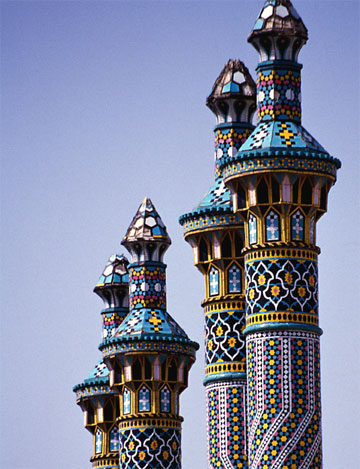
The latest muslim terror weapon? – Minarets?


This should be a joke and sounds like it would make a very funny Monty Pythonesque sketch. It is alas no joke, especially not in Switzerland. There the two year old "stop minaret" movement is backed by the influential ultra-conservative Swiss People's Party (SVP). The campaign has gathered sufficient signatures to ensure that there will now be a referendum which if passed would amend the country’s Federal constitution to include a new article stating that, “The construction of minarets is prohibited”.

With a bit of luck the proposal will be defeated. The Swiss Council of Religions, which groups Jewish, Christian and Muslim leaders, has issued a statement rejecting the proposal. "For the members of a religious community, religious buildings are not only places to gather but also a symbol of their faith and an expression of their reverence for God. For many Muslims, therefore, mosques need to have minarets," the council stated in a 5-page declaration published on 2 September 2009. "Everyone has the right in this country to live their faith visibly, freely and in a community within the framework of the public order," it stated. "This also includes the construction of places of worship that are typical for their respective religion."

The Federal government has already opposed the demand and may try to prevent the referendum, citing reasons of national security and the impact on the country's international relations and interests.

This seemingly surreal piece of political theatre is of course just part and parcel of a wider, ongoing trend of anti muslim measures which have spread across Europe. As well as Switzerland, there have been controversies over mosque and minaret-building in Germany, Austria, Italy, and the Netherlands. While there seems to be an almost daily report of some dispute about muslim clothing, or at least clothing for muslim women. There is the touch of the unreal about this one, at least for people of my age. When I was younger the disputes were all about the shortness or sometimes even the lack of clothing worn by Western women. Nowadays it seems an amazing number of Western men are getting overexcited by muslim women wearing too much clothing. Seems women can’t win either way.

All these disputes are of course about power and the perceived threat to Europe from muslim immigration. At least the SVP in Switzerland are quite open about this. According to Ulrich Schüler, an SVP parliamentarian and leading member of the anti-minaret movement, minarets are political rather than religious. "They are symbols of a desire for power, of an Islam which wants to establish a legal and social order fundamentally contrary to the liberties guaranteed in our constitution," he said.

This idea that Europe is under threat from an Islamic takeover is becoming more and more mainstream. The German author Henryk M. Broder recently told the Dutch newspaper De Volkskrant (12 October) that young Europeans who love freedom, better emigrate. Europe as we know it will no longer exist 20 years from now. Europe apparently is turning Muslim. This article appeared under the title The rape of Europe.

This kind of emotive and essentially irrational headline is unfortunately all too common. It also features in the titles of numerous books on both sides of the Atlantic, where it seems that Americans are equally obsessed by muslim immigration into Europe. A quick glance at Amazon.com throws up such enlightening titles as:
  • Reflections on the Revolution In Europe: Immigration, Islam, and the West
  • Surrender: Appeasing Islam, Sacrificing Freedom
  • Defeating Political Islam: The New Cold War
  • Stealth Jihad: How Radical Islam is Subverting America without Guns or Bombs
  • They Must Be Stopped: Why We Must Defeat Radical Islam and How We Can Do It
  • While Europe Slept: How Radical Islam is Destroying the West from Within
  • Eurabia: The Euro-Arab Axis
  • The Last Days of Europe: Epitaph for an Old Continent
It is not clear what has prompted such vitriolic hatred for what is by any standards a small and persecuted minority. In Europe as a whole muslims make up only around 3.5% of the total poplulation. Even in Switzerland muslims represent only about 4% of the population. It is also interesting to note that in Switzerland nearly all the muslims come from other parts of Europe – Turkey, Bosnia and Albania.

However when it comes to hatred and fear of the other, facts and rational thinking have rarely played any role. Europe and America can invade and occupy muslim countries and in the process kill and maim hundreds of thousands of muslim civilians, with apparent impunity. Yet the presence of a small number of muslims living peacefully in Europe generates in the minds of some Europeans apoplectic visions of imminent catastrophe. It is most ironic that it is in Europe, the continent of the Enlightenment, where enlightenment appears to be in such short supply