Showing posts with label Germany. Show all posts

Tuesday, 13 November 2012

Was Hitler a Charismatic Leader?

This question arises in response to the programme on BBC TV last night, titled the Dark Charisma of Adolf Hitler.  The tv series, three episodes in all, is based on the book of the same name by Laurence Rees.  Judging by the first episode, I am far from convinced that Hitler possessed much in the way of charisma, even of the dark kind.

The programme did not offer anything in the way of what might constitue charisma in a political leader, but simply focussed on Hitler himself.  We were shown lots of footage of the great man in flowing oratory, usually accompanied by flashing lights as a way of alerting us - here comes a bit of charisma - you dumb viewers.  Apart from the staring eyes and a penchant for long tubo-charged speeches, it is not clear just how Hitler was that different from other would be leaders.

For the central point to bear in mind is that for most of his career, Hitler was a spectacular failure.  He was a brave soldier in the First World War, but a complete failure as an artist, as a revolutionary leader - the botched attempt at a putsch in Munich - and a failure to win over many voters in elections.  What changed things for Hitler was the Great Crash and the Great Depression.  Now it seems to stretch things a bit to claim that Hitler's charisma caused the Great Depression.  For no mistake without this depression Hitler was going nowhere.  The response of the German elites - political, financial and business - to this catastrophe was to use mass unemployment as a policy tool.  No wonder extremists began to flourish.

It is also worth remembering that Hitler and his Nazi party never won more than 37% of the popular vote.  That was in the July election in 1932.  By the time of the November election in the same year his share of the vote had dropped to 33%, while the vote for the communists increased.  Not a lot of evidence of charisma here.  It was after the November elections that Hitler was appointed Chancellor, thus giving him the levers to shortly thereafter assume dictatorial powers.  It quite beggars belief that Hitler should have won the Chancellorship after losing votes!  Yet this is what the leaders of the Centre Party did.  In a vain effort to protect their own interests and out of their greater hatred of the communists.  A good lesson to remember when people today extoll the virtues of moderates.  

The programme itself was OK as a basic account of Hitler's rise, though it did flit around too much from  the 1920s to the 1930s.  This lack of a clear narrative framework lessens the value of the programme.  Less about Hitler's charisma and more about the social and economic realities of German would have been welcome.

Monday, 14 May 2012

More Electoral Shocks for the Austerians

After the recent triumph of François Hollande in France and the success of the anti austerity parties in Greece comes another major reverse for those in favour of austerity.  In Angela Merkel's homeland her party, CDU has just suffered a calamitous defeat in North Rhine Westphalia, the most populous of the German Länder.  Her party's vote declined by over 8%, while the main opposition party, the SPD saw their vote share rise.  The SPD will now continue to run the state in coalition with the Greens, but this time with an overall majority.  The photo above shows the victorious Hannelore Kraft the leader of the SPD in North Rhine Westphalia.


This result while a clear set back for Angela Merkel, does not in itself weaken her in the Federal Parliament in Berlin, where she continues to enjoy a clear majority with the support of the FDP.  However it is a further indication of the strength of those opposed to further austerity.  It is worth pointing out that this was not a simple anti incumbent vote as the SPD and the Greens were the governing coalition in Düsseldorf.  Most of all it is further confirmation that the tide is turning in favour of concrete measures across Europe to promote growth.  None of the main parties anywhere is arguing against the need to bring down national debt or to reduce excessive government deficits.  But more and more political parties and groups are vociferously arguing for a longer timetable for debt and deficit reduction and the absolute need to get all European economies growing again.  The situation in Spain continues to worsen with one major bank already effectively nationalised.  Will Greece have a national unity government by the end of today or will there have to be fresh elections next month?  Uncertainty and worry everywhere, with more and more families suffering real reductions in their living standards.  Austerity is manifestly not working.  This week's meeting between François Hollande and Angela Merkel may give us the first indications of whether and how far Merkel is prepared to move.  Alas, we live in interesting times.

Thursday, 16 June 2011

Photo of the Month - May 2011

May was quite a good month for my photo collection, mainly because the last five days we were in Switzerland for the beginning our our visit to Emma & Co.  However I did manage to take a few snaps before then.  The month began with a walk from Wormit to the ruins of Balmerino Abbey.  It is a very pleasant walk which I have now done a few times.  On this occasion we were joined by a little dog, some kind of terrier, who just decided to tag along with us.  Liam gave him the name Scruffy and here he is with Liam, Jamie and Alessio.
 The walk is a grand one for wildlife and flowers.  Here is a lovely butterfly and below, a spread of flowering wild garlic in the woods.  The wild variety gives off a fine subtle aroma.

 The walks ends in the grounds of the ruins of Balmerino Abbey, before you make your way back along the estuary.  Here I am with my two beautiful daughters in a photo taken by Jamie.
May was also a very kind month for the garden with lots of flowers in bloom.  Below is a collage of some of them.
By the end of the month we were in Switzerland, which is always a delight for amateur photographers.  The shop window displays are just amazing.  They are nearly always artistically designed and sometimes as below a bit whimsical as well.
Here are some more displays and a beautiful door.
Our first trip out of Zürich took us to Eglisau, a charming little town on the northern banks of the river Rhine, though it is part of Switzerland.  Here are some of the traditional buildings along with an ultra mordern black metal statue.
And here is me resting by one of the old townhouses.  Photo taken by Alessio.
We followed this up with a trip to Lindau on the northen shores of the Bodensee.  This time we were in Germany, the tiny bit of the Bodensee that belongs to Bavaria.  And a sweet, picture postcard little town it is too.  Below are some of the lovely façades to be seen throughout the town.
Lindau also has an important harbour and here is one of the many ferry ships coming into port between the two guarding towers.
We had delicious Italian lunch in Lindau, which everyone enjoyed as you see from this photo of Kathleen, relaxing after the meal.
Lindau is quite close to Friedrichshaven which is the home of the Zeppelin airships.  They are still around and I close this month with this photo of an airship above Lindau.

Monday, 15 November 2010

Postcards from the Black Forest

This autumn we had the good fortune to make a couple of short trips to southern Germany.   The main one was to Freiburg in the Black Forest.  I had heard a lot about the Black Forest and how beautiful it was and of course I had eaten many a slice of Black Forest gateau, which is very popular in Scotland.  However I had no idea of just large the area is.  I thought it was just the southern tip across the border from Switzerland, but no, the Black Forest stretches all the way north to just before Karlsruhe.  Nearly 200 km in length and about 60 km wide it is a very large area indeed.


On this trip we only managed to get a glimpse of part of the southern Black Forest.  We crossed the border just outside Bad Säckingen on the river Rhine and headed north.  Unfortunately the navigator, yours trully, misread the map and we ended up taking a detour.  This had the advantage of letting us see some of the more isolated parts of the Black Forest.  It also confirmed that the area is well named.  There are a hell of a lot of trees and it does look pretty black most of the time.  The other advantage of this short detour was that just before we re-emerged on the main route we passed by a one family car boot sale.  More accurately the goods were on display in the family's garden.  We stopped and rummaged about and left with a fine range of goodies, including a scooter for Alessio.  All for next to nothing.


We continued on our route heading for Freiburg and around lunchtime as we passed through a winter ski resort, Muggenbrunn, we saw what looked like a delightful restaurant.  And delightful it was.  The Hotel Grüner Baum is in a traditional building and the restaurant serves traditional Black Forest food, all served by waitresses in traditional costumes.  It was a warm and sunny afternoon - what more could one want.  Here is a happy Emma relaxing after the meal.
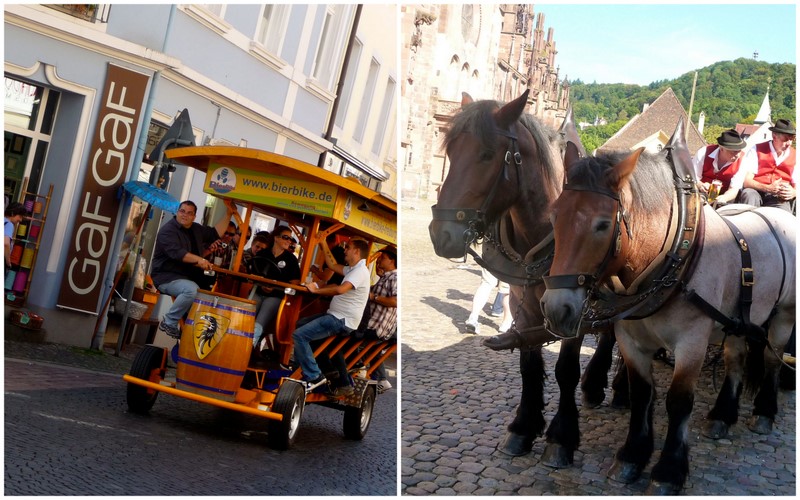
Suitably refreshed, we were soon in Freiburg im Breisgau, our destination.  This is another little gem of a city and the heart of the Black Forest.  Full of beautiful old buildings and cobbled streets and alleyways.  Most of these old buildings were ablaze with colour and some were covered in ornate decorations.  You can get an idea from the collage below.
The main public space in Freiburg is by the Munster, a fine building itself.  The next photo is of part of one of the very colourful buildings in this square.  This is followed by one of the delightful narrow streets or alleys.

Freiburg now has the full complement of modern transport options, including some lovely trams.  However it also boasts a couple of more unusual and older ways of getting around the place.  Consumption of lots of beer seems to be an obligatory part of at least one of these options.
Much of the charm of Freiburg comes from the surviving examples from its past.  Like many medieval towns, Freiburg had fortified gates into the old town.  Two of them survive in very good condition.
The pavements of Freiburg were most interesting.  Many of them were covered with intricate mosaics.  Most of them represented the shop or business in the building beside the mosaic, though some just seemed to be decorative.  I loved them all.  Here are a few.
Also at street level were the gutters which crisscrossed the town.  They all had running water in them and most were in good condition, free from litter and other detritus.  They are clearly a tourist attraction for children as you could buy specially made little boats to pull through the water.  Alessio found this great fun.
 All in all Freiburg was a wonderful place to visit.   We were blessed with lovely warm sunny weather, which always helps.  However Freiburg was just a delight.  The cafés and restaurants were all very enticing and the ones we sampled excellent both in service and food.  Freiburg is also very lively place with throngs of people strolling about or just sitting in the sunshine supping a coffee or a beer.  There were also plenty of street entertainment to keep everyone amused, as with this pretty juggler.
On the Sunday afternoon as we drove back to Zürich we had two more adventures.  The first was one of these totally unexpected pleasures, when you by chance come across something delightful.  In this case we happened to drive past a little apple festival in the Elzacher valley.   A traditional brass band was on hand to provide musical accompaniment to the many guests who were happily gorging themselves on an irresistible selection of local goodies.   Though the main excuse was to celebrate the range of products from the humble apple, other fruit products were on sale.  A very popular liquid refreshment was a glass of Sekt, the German version of champagne, doused with a little fruit syrup.  There was a great range to choose from and all looked good.  We managed to try a couple each and bought some bottles to try out back home.   The festival was also an opportunity to see some of the traditional presses that used to be used in extracting the juice from apples.  Below is a collage from the festival.
Our next stop was the Black Forest Open Air Museum Vogtsbauernhof which is near Gutach.  Emma had found out about this museum on the internet and thought it would be interesting to Alessio.   It is in fact a wonderful museum.  A collection of original farm buildings from all over the Black Forest which have been lovingly moved and restored to their former glory in the Vogtsbauernhof.  Some of the buildings are very large and impressive, like the one below.
Inside each building you can see the actual implements used in the past, and in some cases the living quarters of the people who lived on the land.  There is also a fine collection of farmyard animals.  The collage below shows some of them.
Unfortunately Alessio was not particularly impressed with all this history.  Luckily there was an extensive playground for children, so he will probably have fond memories of his visit.  For the rest of us there was so much to see and do.  If we had more time we could have made our own scarcrow.  Kathleen was particularly keen on this.  There were also some living examples of traditional costumes to admire, as can be seen in the photos below.

This was our first trip to the Black Forest and most enjoyable it was.  We did have glorious weather.  However everyone we met was very helpful and kind, and everyone seemed to be pretty happy with life and enjoying themselves.  There is so much more to see and do in the Black Forest, it is a walker's paradise for example, that I hope to return again.

Thursday, 23 September 2010

Postcards from Konstanz

This autumn we had the good fortune to make a couple of short trips to southern Germany.  From Zürich it is a relatively short journey to get to Germany.  Our first trip was to Konstanz.  This was in fact our second visit to Konstanz.  The first was in December 2001, when Cosimo drove us there to see the Christmas market.  It was lovely, but was very cold and it snowed all the time.  Still we had great lunch in a restaurant in an old railway carriage and managed to wander around the market a bit.  The following photos give an idea of how cold it was.

This time we went by train with Emma and Alessio.  The ostensible reason for the trip this time was to visit the Sea LIfe Centre.  This is right by the lake, just opposite the railway station - very handy.  Unfortunately the centre itself is not that great.  All the creatures seem stuck in pretty cramped tanks of one kind or another.  The displays were well enough arranged and there was lots of information about the river Rhine and the sea creatures.  One thing that did take me by surprise was to discover that flat fish have faces, with eyes and mouth and so on.  I suppose I had never seen a flat fish from eye level before.  Below is a photo of one.  Strange and lovely creatures.
After a quick tour of the Sea Life Centre we then wandered around the city itself.  Konstanz is bisected by the river Rhine and lies on the banks of the Bodensee, or Lake Constance as it is known in the English speaking world.  It is a very beautiful city which dates back to the middle ages and was the venue for one of the Catholic Church’s famous or should it be infamous Councils in 1414-18.  This Council is in fact the inspiration for the stunning 10 metres high statue of Imperia which stands at the entrance to the harbour.  It was created by Peter Lenk and erected in 1993.  Imperia was apparently a courtesan who features in a short story by Balzac.  So this statue is a bit of a satire on the Church.
The old part of the town is still replete with centuries old buildings.  It is a joy to walk around and as it is quite a small city you can walk around the whole place quite easily.  An interesting fact about Konstanz is that it was not bombed during the Second World War.  The city is contiguous with Switzerland and apparently the Konstanzers kept the city lights on during the nights so that allied bombers would think it was part of Switzerland.  True or not, the city does have some remarkably intact buildings.  A few can be seen in the following collage.
Konstanz is also, it seems, a favourite place for couples to get married.  The most popular place is the old Council Chambers, a Renaissance building in the heart of the old city.  Here there is a special wedding room and a lovely inner courtyard for receptions.  While we were there, some kind of reception was in fact in process in the courtyard.  Here is the beautiful façade.  If you look carefully you can just spot some of the participants at the reception.
Konstanz is quite famous for its churches and the main cathedral is very impressive inside, with lots of baroque decorations as can be seen in this collage below.
For lunch we found a really nice Italian restaurant which served very good traditional Italian food, which we all thoroughly enjoyed.  The prices were cheaper than in Switzerland too.  Alessio liked the place and was quite taken by the many Pinocchio statues lying around the place.  He even got one as a present to take home.
In addition to the city itself, Konstanz is an attractive place to visit for its situation on the Bodensee.   This is the third largest lake in Europe and is shared mainly by Germany and Switzerland, though Austria has a small part of the lake at Bregenz.  We have visited Bregenz and a few of the Swiss lakeside towns and all are very pretty and well worth a visit.  If you want to find out more about Konstanz and the area your can visit their website here.  I end with this collage of scenes from the waterfront in Konstanz.