Monday, 7 November 2011

Photo of the Month - October 2011

October was quite an active month.  I managed to get in four walks and a visit to Edinburgh.  We also had some lovely weather during most of the month.  Which meant there was still lots of colour in the garden.  Here is our arrangement of pots outside the front door, followed by a lovely gentian from the Barnhill Rock Garden.

The good weather led to a few walks.  One was to Kinpurney Hill near Newtyle, not far from Dundee.  I did this with Elena and the boys.  It was a lovely, sunny, but windy day, and we had a great time.  The photos below show Elena and Liam going up the hillside, then all three at the summit beside the gothic looking tower.

Another outing took us to a jaunt up to the Hopetown monument just outside Cupar.  We did this with John and Diana on another lovely day.  The monument is a very large tower built in the 1820s which looks like this.
I also managed to get in a couple of hill walks with Frank.  One was to the hills at the Spittal of Glenshee.  Another fine day, though the upper slopes were by then already covered in snow.  Here is a view looking across the glen to the higher peaks.
The visit to Edinburgh was with Elena and the boys where we spent all the time in the re-opened National Museum of Scotland.  This has all kind of exhibits and is very child friendly.  Just about everything is included - from dinosaurs to racing cars.  One part of the museum is dedicated to the history of Scotland and this is particularly interesting.  Below is a specially made saltire which was taken into space by an astronaut with Scottish ancestors, followed by a wonderful example of the feathers from a peacock and then three bicycles from different eras.  The final bike is the one built and used by Graham Obree when he broke the world speed record.


I conclude with an unusual momento from our visit to Zermatt.  There I bought a bottle of white wine from the highest vineyard in Europe.  This is found in Heidadorf Visperterminen and is 1150 metres high.  I bought a bottle of Heida Visperterminen from the St. Jodern Kellerei.  I took it all the way back to Scotland and very pleasant drinking it was too.  Cheers everyone!

Thursday, 3 November 2011

Greece and the Euro - What Next?

The drama of recent days continues unabated.  As of this Thursday afternoon it looks like there will be no Greek referendum on the EU deal, but instead the main opposition party has agreed to support the deal in Parliament.  Much relief all round, at least in Eurozone countries and in the UK government.  It is far too early to know what will in fact happen and how this will develop over the coming days and weeks.  But it is useful to step back a bit and try and figure out what is really behind all this turmoil.
In particular it would be helpful to get away from simplistic blame games.   It is all the fault of Greece shout some, while others equally loudly yell that it is the nasty EU which is punishing the poor Greeks.  It would also be good to disentangle the situation in Greece from the wider problems faced by the Euro.
In the case of Greece it is important to remember that the crisis facing that country is primarily due to the mismanagement of its public finances.  The country faces deep seated problems which previous governments have avoided.  It is to the credit of Papandreou and his current government that it is the first Greek government to face up to this reality and to begin to take measures to modernise the economy.  This is something that Greece needs to do and there is no doubt that this will involve great suffering for many Greeks.  However there is no real alternative.  In passing it is worth pointing out that devaluation (leaving the Euro and going back to the Drachma) would make no difference to this.  Unless a country takes the necessary steps to modernise its economy, devaluation makes no long term difference to a country.
The big problem for the country is that this particular challenge comes at the same time as the rest of the EU and most of the world is in the midst of a massive financial and economic crisis.  The country has also been handicapped by the neo-liberal nonsense that currently passes for economic wisdom in most of the world.  More and more austerity measures simply prolong the suffering of Greek people and postpone any recovery.
The EU and the European Central Bank (ECB) have however done nothing to help Greece.  All this talk of Greek bailouts is just nonsense.  The so-called bailouts are designed to bail out EU banks, in particular those in France, Germany and Belgium, which are most exposed to a Greek default.  The EU lends money, at exorbitant interest rates, to the Greek government, to avoid a default.  The money does not go to helping Greek people, who are suffering from cuts in wages and pensions and high unemployment.  At the same time the EU and the IMF are forcing the Greek government to introduce even more drastic austerity measures, which can only lead to less growth in the economy and thus increase the likelihood of a Greek default.
This whole approach has of course clearly failed.  The latest deal included a 50% loss for the banks.  And most observers reckon that sooner or later Greece will have to default on the remaining 50%.  It is all so depressing.  The solution to the crisis, both in Greece and in the Eurozone as a whole is pretty clear.  Greece needs to have its debt written off and have access to new funds at affordable interest rates.  The country also needs to carry out fundamental reforms to its economy and public finances.  But if this is to work this needs to happen in the context of a growing economy.  Not just in Greece, but in the whole of the EU.  Something similar needs to happen in other Eurozone countries.  Not necessarily a write-off of debt, (Greece is the worst in this respect) but in access to funds at affordable interest rates.
This is not difficult to do.  If the ECB were to act as a normal central bank, like the Bank of England or the Fed in the USA, that is to be a lender of last resort, then the core of the crisis would disappear.  The ECB has the money, it can print as many Euros as it wants.  If it announced that the ECB would buy Greek, Italian, Spanish, Portuguese and Irish government bonds at an announced interest rate, (a low one) then the markets would cease to speculate against these countries.  Not only that, the ECB would probably not need to buy that many bonds.  Once the market realised that the ECB was serious the various bondholders would return to the market.  Where else are they going to put their money - under their pillows?
At the moment some EU countries are opposed to this, especially Germany, which because of its own history is still frightened of the dangers of inflation.  However in the present economic climate inflation is not on the horizon and the real worry is the risk of a deep seated recession.  There is also the problem of creating some kind of supranational governing body for the Eurozone.  It seems the governments concerned have agreed to move towards this, but probably need to to do so quicker.
In many ways all this suffering in Greece and elsewhere is so unnecessary.  The means are there to lessen the impact of reforms and to get the economy moving again.  The lessons are there for all to see going back not just to the great depression in the twenties and thirties, but all the way back to the 1820s as Brad DeLong explains here.  For more on the need for the ECB to act as a lender of last resort see here.

Sunday, 30 October 2011

Bargello Update - October 2011

My recent stitching work started and ended with something completely different.  Though most of my work continues to be various forms of Bargello, these two funnily enough were not.  The first was a Zigouigoui or two Zigouigouis to be precise.  I had never come across or even heard of such a thing before, but found them in Louison's ever interesting Biscornu blog.  A Zigouigoui is apparently a very small cushion and some stitchers had used Louison's biscornu designs to make a Zigouigoui.  So I decided to join them and used grilles 99 and 104.  Here are the completed pieces.
 The fabric is 19ct Aida in Christmas red and one zigouigoui is in emerald green and the other in electric blue.  Both use two strands of DMC cotton thread.  The now hang by our fireplace.


For my next project I finally managed to use up just about all of my stash of wool threads.  The design comes from Bargello Magic by Pauline Fisher and Anabel Lasker.  It is No 5 in a series called Fused Diamonds.  It is quite large for me - 38cmx46cm.  This is what it looks like.
The fabric is an antique double canvas and the colours were just what was left in my stash.


Next up was another Bargello design - Petals from The Bargello Book by Frances Salter.  The fabric is 18ct Aida in pale green and the threads are two strands of DMC cotton.  So far I have completed two pieces in this design.
The first was in violet and lavender and the second in shades of blue.  I  intend to do one more of this design in another colour scheme.  The idea is to hang them together in a vertical frame.


While in Switzerland I gave away some of my work - I am running out of space to keep them all.  Emma's friends and in-laws are the happy recipients.  I brought out some other examples of my work just for show and some of her friends were quite keen to get their own version of some of them.  It's always nice to make something for somebody, especially if it's someone you know.  So I now have to stitch three versions of No 5 in the Five Easy Pieces series.  They all wanted the same colour scheme.  Here is the first one.
Arlene wanted design No 3 from the same series, but in a different colour scheme, which made it a bit more interesting for me.  I have now completed this in reds and plums.
I need to get the remaining two pieces finished before Christmas as Emma is due to take them back with her after her holiday here.


The final piece I have just completed is a first for me and pretty much my own design.  I say pretty much as the basic pattern is an example of a Fractal.  Emma's brother-in-law, Luca, introduced me to the world of fractals.  I won't even try to explain what a fractal is, but if you google some images you will discover a weird and wonderful world out there.  Anyway, I used a particular fractal as the basis for this particular project.  It is an octomino and this is the basic shape, which as you can see is made up of eight squares - hence the name.
This octomino can then be used to make up what is known as Brigid's octomino similarity tiling.  
Basically eight octominos combine to form a bigger octomino which in turn combine to make an even bigger octomino.  The process can go on indefinitely, though you do end up with an awful lot of octominos.  The one above has 64 of them.  The next in the series has 512!


I chose the one with 64 octominos for my design.  To get a good contrast I used a bright Christmas red 18ct Aida fabric.  To highlight the octominos I used two colour schemes.  Blues for the outer octominos and greens for the inner ones.  Here is what it looks like.
Each square of the octomino is a Scotch stitch over two intersections.  I will experiment further with this pattern - different stitches, different colours and any other variations I can come up with.


I close this post with a photo of an earlier piece which I stitched for Emma.  It has a centre in Ripples surrounded by Hungarian stitch in yellow and orange.  Unfortunately the photo doesn't clearly show the colours in the centre - they are white, brown and green.  It is now finished and sits in the middle of a fabric I found in a fabric shop.  A simple alternative to framing.  Good stitching to one and all.

Thursday, 27 October 2011

Saving the Euro?

The recent EU summit meeting in Brussels has surprised most people.  It looks like they have come up with a three point plan to save the Euro.  And the immediate reaction of the markets has been very favourable.  After months of wrangling and doing very little have our leaders finally lanced the boil of the financial crisis?
The short answer is no, but they seem to have come up with enough to pacify the markets for the time being.  This involves a 50% haircut on Greek debt, a further recapitalisation of banks and an improved fund (the EFSF) to provide medium term support to Italy and Spain.  The key words here are medium term.  Let’s say until spring of next year.  By then a lot more will need to be done.  
Basically there are two immediate challenges for the Eurozone.  The first is to get their own house in order to ensure that the likes of Spain and Italy are protected against further speculation.  To this end the Eurozone countries need to come up with a credible plan and timetable for creating some kind of fiscal union.  It need not be a full fiscal union as the USA, but it needs to be credible enough to satisfy the markets.  They need to start work on this soon and we will need to know the outcome by early next year.
The other challenge facing the Eurozone, along with most of the rest of the world, is how to get their economies growing again.  For example if Greece does not start to grow again very soon it will once again be unable to repay its national debt, even with the current 50% haircut.  The same will apply to Italy and Spain.  How this growth is to happen as long as the EU, including the UK, stick to harsher and harsher austerity measures is a bit of a mystery.  Things are not looking good.

Monday, 24 October 2011

A is for Jane Austen

This is the first post in what I hope will be an A-Z of my favourite writers.  Jane Austen is not just first on the list, but without a doubt one of my all time favourite authors.  I’ve read all of her novels, most more than once.  And enjoyed them all apart from her early attempt at Gothic horror - Northanger Abbey. 
What I find most alluring is her use of language.  Not just the famous use of irony, but the way she is able to turn a simple description or tale into a work of beauty.  It is just a great pleasure to read any of her works.  Here for example is the first sentence of Emma, where the little word seemed changes what is an apparent glowing tribute to the novel’s heroine into something like its opposite.  “Emma Woodhouse, handsome, clever, and rich, with a comfortable home and happy disposition, seemed to unite some of the best blessings of existence; and had lived nearly twenty-one years in the world with very little to distress or vex her.
Another example of her art of using a character’s good points to expose that person’s worst aspects comes in Persuasion with this delightful and deadly character assassination of Walter Elliot.  “Vanity was the beginning and the end of Sir Walter Elliot's character; vanity of person and of situation. He had been remarkably handsome in his youth; and, at fifty-four, was still a very fine man. Few women could think more of their personal appearance than he did, nor could the valet of any new made lord be more delighted with the place he held in society. He considered the blessing of beauty as inferior only to the blessing of a baronetcy; and the Sir Walter Elliot, who united these gifts, was the constant object of his warmest respect and devotion.
The main complaint I have about her novels is that they contain a few too many stock, comic characters that stretch the imagination to believe in.  Emma’s father for example or Mrs Bennet in Pride and Prejudice.  Perhaps there were real people like them in Austen’s time.  For another of her strengths is that her novels are very much set in a particular place and time.  Nobody seriously challenges the existing order.  While her novels all feature very strong and powerful women characters, they all succeed within the existing social norms.  A good marriage and a reliable income was the sine qua non for a contented life.  Not much has really changed.
There are now so many editions of her novels available, that a reader faces an embarrassment of riches.  If you don’t want to buy a book and are happy to read from your computer screen austen.com has all her works available online for free.
Jane Austen’s works have proved very popular with film makers, both for the big screen and TV.  One of the most successful and critically acclaimed productions was the 1995 TV adaptation with Jennifer Ehle and Colin Firth in the main roles.  With six one hour episodes this mini series managed to include most of the novel’s key scenes.  
Of the film adaptations my favourite is definitely Sense and Sensibility.  And there are two fine versions to cherish.  The more well known is the 1996 version directed by Ang Lee with a screenplay by Emma Thompson, who also starred in the film alongside Kate Winslet, Hugh Grant and Alan Rickman.  

For something less well know and completely different I would recommend Kandukondain Kandukondain (2000), the Tamil language film.  Also known as I Have Found It, this wonderful Bollywood type film is a sheer joy to watch.  Directed by Rajiv Menon who wrote the screenplay along with Sujatha.  The film stars Aishwarya Rai, Tabu, Mommootty and Ajith Kumar with music by A R Rahman.  This version of Sense and Sensibility sets the action in modern day Tamil Nadu.  It works wonderfully well and the music and dance sequences are a joy to behold and hear.  If you do get a hold of a copy watch out for the song and dance sequence filmed at our very own Eilean Donan Castle in western Scotland.  To whet your appetite you can see this for yourself here.

Friday, 21 October 2011

It’s Osborne’s Recession

Recently we have had a seemingly never ending succession of bad news about the UK economy.  All the indicators and forecasts suggest that we are in for a very bumpy ride ahead.  If we are not in recession we are pretty close to it.  It also seems that our national debt is getting bigger not smaller.  Now all this is bad news for our nasty Coalition and the Chancellor in particular.  So he and his chums in the media have taken to blaming the crisis in the Eurozone for our troubles.  If only these fickle foreigners would get their act together then everything would be fine and dandy over here.
No matter how loudly and how often this line is repeated it remains untrue, and as near a lie as one can get.  Even the IMF, that bastion of fiscal austerity has challenged the government’s li(n)e.  According to their latest report on Europe, the reason the UK has experienced a large build up in public debt is because of the costs of the large loss of output following the crisis.  And of course this large loss of output is directly down to decisions taken by one George Osborne.  Raising VAT, freezing public sector wages, reducing welfare payments and engineering a large rise in unemployment through cuts in the public services can only have one outcome - a severe reduction in demand leading to a large loss of output.  Not quite the story of public sector profligacy the government is usually so keen to tell.
The recent forecasts for the economy are also very revealing about the true source of our economic woes.  Not only do they agree that there is likely to be substantially less growth in the economy overall - down from 2% to 1%, but the source of this anemic growth has changed.  More details here.  Forecasters now expect domestic demand to subtract 0.4% from the economy as consumers, business and government all cut back whilst they expect net trade to add 1.3%, much more than previously.  So despite the Eurozone crisis our exports are likely to hold up.  What this means of course is that our continued economic woes are all down to Osborne himself and his misguided policies.  Time to stop trying to blame someone else.

Monday, 17 October 2011

Take Six Books - October 2011

I have changed this to Six Books as I have recently bought some books.  Though I have decided to keep with an audiobook.  So here is my current crop of books.
The book I’m currently reading - Brighton Rock by Graham Green.  This is the reading group’s choice for the month.  I’ve never read it before, neither have I seen either of the film versions.  So I was quite surprised by the novel.  Not at all what I expected.  It is a darkly funny tale at times and betrays Greene catholicism or at least its obsession with sex, guilt and death.  Very enjoyable.
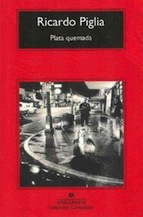
The last book I finished - Plata Quemada by Ricardo Piglia.  At last I have got round to reading something for the Ficciones Argentinian reading challenge.  Based on a true bank robbery in the 1960s in Buenos Aires.  Not a traditional crime novel in any sense, as we know from the beginning who did it and also know more or less how it ends.  However instead Piglia takes us inside the minds of the main characters and a pretty weird, violent and unattractive place this is.  Good book.
The next book I want to read -  Echoes from the Dead by JohanTheorin.  This is part of my gradual exploration of new Scandinavian writers.  Theorin is from Sweden and this is his first novel.  It is set in the island of Öland off the east coast of the country.  All about a young boy who went missing some time ago.
The last audiobook I listened to - The Gallow’s Bird by Camilla Läckberg.  This is the fourth of Läckberg’s novels I have listened to and all have been very enjoyable.  Läckberg is another Swedish crime writer, and The Gallow’s Bird, like the others, is set in a small town on the west coast of Sweden.  As with the others in the series this is as much about the personal lives of the detectives as the actual murders.  A pretty chilling tale though.

The last book I was given -  Willing Flesh by Adam Creed.  This will be a new one for me, as I have never come across the author before.  Creed is an English writer and this is the second of his novels to feature Detective Inspector Staffe.

The last book I bought - To the Ends of the Earth by T. M Devine.  A rare occurrence for me - buying a book!  Professor Devine’s book is the history of Scotland’s global diaspora as the subtitle puts it.  It has had some great reviews and the man himself came to Dundee to give a talk about the book.  So I just had to get a copy.  This is one book I will take my time to read.  One to dip into and return to.